




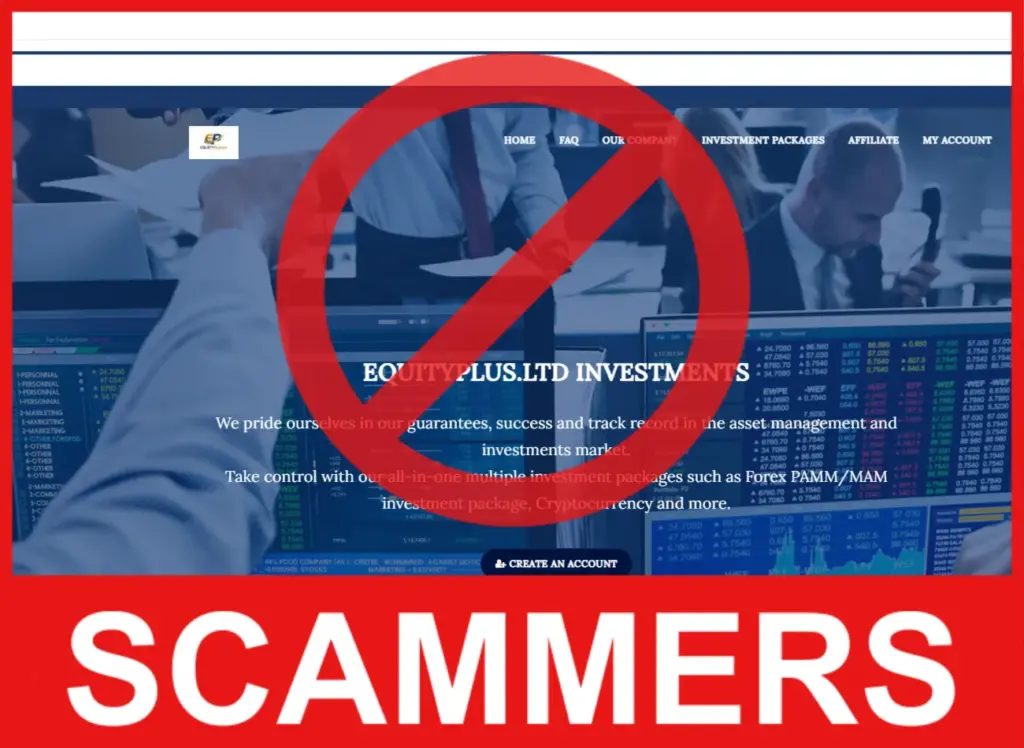
People who are new to financial markets or looking for investment opportunities online often face the difficult challenge of separating legitimate brokers from fraudsters. Scammers know that ambitious investors can be easy targets when offered big profits with little risk. In this environment, fraudulent brokerage sites are popping up more frequently, making convincing promises and using polished language to lure unsuspecting clients. One of these sites is Equityplus.ltd. At first glance, Equityplus.ltd appears professional. The website has a clean design, financial buzzwords, and claims of profit potential. However, below the surface, this broker lacks the basic elements of transparency and legitimacy that define a trusted financial institution. Equityplus.ltd has been flagged by financial watchdogs and risk analysis services as unregulated, unreliable, and possibly linked to a wider network of scam operations. This article is intended to give readers a clear and honest look at Equityplus.ltd, including what is known about the company, how it operates, what warning signs exist, how scam brokers typically ensnare victims, and how people who have lost money to such operations can seek help. It is written in simple language to ensure that even readers without prior trading experience can understand the danger and protect themselves. The ultimate goal of this article is not just to expose equityplus.ltd, but to encourage anyone affected by similar scams to seek professional support. Recovery after a scam is not something you have to navigate alone. Firms like DNB Forex Review specialize in supporting victims, working to document the fraud, pursue refund pathways, and offer guidance that individuals may not be aware of.
Information About the Fraudulent Broker
Equityplus.ltd markets itself as an online brokerage service, a platform where individuals can trade financial instruments and profit from the global markets. The website uses industry language, charts, and the appearance of a legitimate trading environment. It might mention trading accounts, investment opportunities, and projected returns. However, deeper investigation reveals a different picture. The first sign that something is wrong is the lack of any verifiable licensing or registration with reputable financial authorities. Legitimate brokers must be licensed in the countries where they offer services. Licensing serves to protect investors through accountability, financial audits, and legal requirements. Equityplus.ltd fails this basic test. Public warnings from financial regulators indicate that no valid license exists under this name, and that the company is not authorized to provide investment services. This is more than a minor compliance failure; it is the most important red flag any prospective client should consider. In addition to missing licensing, the broker’s website lacks transparent company information. There is no publicly verifiable corporate registration, no named executives with verifiable credentials, and no audited financial disclosures. Instead, the site relies on generic marketing claims, vague contact information, and promotional language designed to make visitors feel that they are dealing with a professional institution. Risk analysis services that evaluate website safety give Equityplus.ltd an extremely low trust score. That means the site is associated with risky activity and lacks the characteristics expected of a trustworthy financial platform. Often such sites share hosting infrastructure with other scam domains, making it easier for scammers to launch, abandon, and relaunch sites without accountability. Many scam brokers also display fabricated testimonials, quotes, and fabricated trading results to create an illusion of success. These do not withstand scrutiny and do not represent independent verification of real user experiences. When you search for authentic user conversations outside the broker’s own website, there is little to no evidence of satisfied customers. What you do find are general discussions of similar scam brokers, patterns of withdrawal problems, and countless warnings about online trading fraud. In short, Equityplus.ltd functions less like a broker that executes trades on behalf of real clients and more like a front designed to collect client deposits while offering no meaningful financial service in return.
Verification of Company Data
The process of verifying a broker’s legitimacy begins with checking whether the company is registered and regulated by recognized financial authorities. Reputable regulators have clear public databases where investors can confirm the status of a broker. These databases list the company name, registration number, address, authorized services, and often the history of regulatory actions. Equityplus.ltd is absent from such databases. Financial regulators explicitly warn that this broker has no authorization to offer financial or investment services. This absence of regulation means that if the broker engaged in deceptive or fraudulent behavior, there is no regulatory body to enforce consumer protection or compensate victims. Licensed brokers are required to keep client funds in segregated accounts, submit to financial reporting, and comply with rules designed to protect investors. Equityplus.ltd does none of these things. Even beyond regulation, legitimate financial firms disclose corporate details such as incorporation documents, business addresses, and principal executives. Equityplus.ltd offers minimal or no verifiable background information. There is no transparent team behind the company that can be independently confirmed. No credible track record, no corporate history, no audited results. Scam analysis tools often check for clues such as how long the domain has existed, whether it appears on blacklists, and whether it uses shared hosting with suspicious sites. Equityplus.ltd scores poorly across these metrics, which is consistent with many fraudulent schemes. Scammers typically cycle through similar websites and reuse infrastructure to avoid accountability, making it difficult for victims to track down a responsible entity after they lose funds. The lack of verifiable licensing and registration is not a matter of negligence or a paperwork error — it is central to the broker’s operation. Without proper oversight, the company is free to withhold funds, alter trading results, and manipulate client accounts without consequence. Investors have no legal recourse against a broker that does not exist in the eyes of the law. When confronted with such warnings and missing data, the safest assumption is that the broker is not a legitimate financial service provider. Instead, it is operating in a legal gray zone or outright fraud.
Exposing the Broker as a Fraudster
There are patterns and behaviors common to fraudulent brokerage operations that have been documented over many years. These patterns appear clearly in the case of Equityplus.ltd and serve to highlight why it should be regarded as a scam. One of the strongest indicators of fraud is the broker’s insistence on upfront deposits without providing any real proof of legitimate trading infrastructure. Scam brokers often take an initial deposit, show inflated trading figures designed to mislead, and then create artificial barriers when the client tries to withdraw money. These barriers can include sudden demands for additional “verification fees,” “tax payments,” or other obstacles that increase the victim’s financial commitment. Another common signal is aggressive customer outreach. Scammers may contact potential victims through social media ads, unsolicited messages, or cold calls, promising high returns and exclusive opportunities. Once the victim is engaged, the broker pushes them through a series of persuasive messages designed to build trust quickly. Real brokers rarely use high‑pressure tactics or insist on immediate deposits. False claims about regulation are another hallmark of fraudulent brokers. Prominent financial regulators have issued warnings that Equityplus.ltd is not authorized, but the broker’s website may include misleading references to regulators or fake certificates designed to imply legitimacy. These statements are not backed by official registration, and they deceive investors into believing that the platform is safe when it is not. Scam brokers also engineer their websites to feel urgent and exclusive. They may highlight minimal information about risk while emphasizing potential gains. Genuine brokers always include clear disclosures about the risks of trading, the possibility of losses, and information about regulatory protections. Perhaps the most troubling sign is what happens when clients attempt to retrieve their funds. Investors report that once a withdrawal is requested, the broker becomes unresponsive or imposes impossible conditions. Sometimes the support team suddenly disappears, contact methods stop working, or the site itself becomes inaccessible. This orchestrated disappearance is not a glitch — it is a strategy to ensure that funds remain in the hands of the scam operators. In short, Equityplus.ltd exhibits the same warning signs seen in many financial frauds: lack of licensing, aggressive marketing, misleading regulatory references, artificial trading displays, and withdrawal obstacles. These elements collectively expose the broker as a fraudster rather than a legitimate financial institution.
Fraud Broker’s Deception Scheme
To understand how Equityplus.ltd operates, it is useful to view the scam as a sequence of psychological and technical tactics designed to build trust fast and extract funds slowly. The first part of the scheme involves contact. Scammers reach out to potential victims in ways that feel personal or coincidental. They may pose as financial advisors, wealth coaches, or investment consultants, using friendly language and urgency. This initial contact is carefully crafted to lower skepticism and make the victim feel chosen or fortunate. Once contact is made, the scammer directs the victim to open an account on the Equityplus.ltd platform. This platform is designed to resemble a legitimate trading interface, with dashboards, statistics, and account balances. The victim sees numbers moving, apparent gains, and a sense of control. In reality, these numbers are controlled by the scam operator, not connected to real markets. After the fake platform is set up, the scammer encourages the victim to make a deposit. Often the initial deposit is modest, just enough to feel safe but large enough to begin the exploitation. At this stage, the victim may even be allowed to withdraw a small amount successfully. This reinforces the illusion that the system works and builds confidence. However, once larger sums are deposited or a significant profit is shown, the scammer begins to introduce obstacles. Requests for additional documentation, unexplained fees, or new account verification rules appear. Each request feels official and increases pressure on the victim to comply, creating a cycle of escalating financial commitment. Over time, the victim may sense that something is wrong, but by then they have already deposited significant funds and are emotionally invested in the belief that they will eventually receive a return. The scammer exploits this emotional investment to demand even more money, promising that once the final payment is made, funds will be released. In the final stage of the deception scheme, the scammer cuts off communication. Contact details stop working, access to the platform is blocked, and the victim is left without a way to retrieve funds. This final disappearance is the culmination of the scheme — the point at which the fraudster ensures they have extracted as much money as possible before leaving no trail behind.
How to Get Money Back from a Scam Broker
Realizing that you have been defrauded by a broker like Equityplus.ltd is a painful experience. Many victims feel helpless, frustrated, and unsure where to turn. Yet there are pathways, often complex but real, that can help in the pursuit of recovery. The first step is to understand that you are not alone. Specialized firms exist whose entire purpose is to help victims of online financial fraud. These firms know the tactics used by scam brokers and understand how to challenge them. They assist victims in building a detailed record of the fraud, submitting formal complaints, and communicating with financial intermediaries. One important avenue is working with your bank or payment provider to initiate a recovery process. Many financial institutions have mechanisms to dispute transactions, especially if there is evidence that the payment was made to a fraudulent entity. A well‑documented case stands a much better chance of success. Another pathway is legal action. Even though the scam broker may not be registered in your country, there are legal specialists who can pursue cases across borders, contact relevant authorities, and explore whether any assets can be frozen or traced. This is not simple work, and it often requires professional support, but it has been successful in many cases. Reporting to law enforcement and regulatory agencies also plays an important role. While regulators may not be able to compensate victims directly, they can build cases against fraud operators that increase pressure on them and help prevent further victims from being harmed. Official complaints contribute to broader investigations that can lead to criminal charges or sanctions. In addition to formal mechanisms, emotional and community support is essential. Recovering from a scam is not just about money; it is also about rebuilding confidence and learning how to protect yourself in the future. What matters most is not to remain silent. Reaching out for professional help, documenting everything that happened, and being proactive about recovery significantly increases your chance of getting funds back — or at least preventing future loss.
Negative Reviews About the Broker
Because Equityplus.ltd is a relatively new scam operation, there are not yet large numbers of published victim testimonies mentioning this broker by name. However, the patterns associated with this domain match the experiences shared by victims of similar fraudulent brokers on public forums, complaint boards, and financial risk discussion sites. People who have fallen prey to scam brokers often describe the same sequence of events: they are initially contacted in a friendly or persuasive manner, they are encouraged to make a deposit, they see apparent profits, and then when they try to withdraw money, they encounter sudden requirements for additional payments or unverifiable excuses. Many victims express frustration with the broker’s customer support, describing unresponsive or evasive representatives once a withdrawal is requested. Some report being asked to pay additional “taxes” or “processing fees” that were never mentioned at the start. Others speak about being transferred from one support person to another, each offering a different reason why the funds cannot be released. Although specific reviews of Equityplus.ltd are limited, the warning signs match the broader community narrative about fraudulent brokerage schemes. Where there are similarities in marketing language, lack of licensing, and questionable domain credibility, the risk of negative outcomes becomes very high. In the absence of direct testimonies, the volume of warnings from regulators and risk analysts serves as an indirect review. When multiple sources identify a broker as unauthorized and high risk, it reflects a broader pattern of dissatisfaction and harm that victims experience.

A Useful Insight: Why Scammers Target Everyday Investors
One aspect that is often overlooked in discussions about fraudulent brokers is the psychology behind why people fall for these schemes. Scammers understand human behavior and exploit common desires — the desire for financial security, the hope of achieving more with limited capital, and the fear of missing out on an opportunity. Fraudulent brokers often appeal to emotions rather than logic. They create a sense of urgency, implying that the opportunity is limited or that quick action is required. They present testimonials and success stories that feel personal and relatable. They use persuasive language that lowers skepticism and increases trust within a short time. It is important to recognize that falling for a scam does not mean a person is unintelligent or careless. Scammers spend a great deal of effort studying how to manipulate decision‑making, build rapport, and create the illusion of safety. When someone is under emotional pressure or genuinely hopeful about improving their financial situation, they are more vulnerable to these tactics. Understanding this dynamic helps victims approach recovery with self‑compassion rather than self‑blame. It also highlights the importance of education, skepticism, and verification in all financial interactions. Being able to distinguish between legitimate opportunities and fraud requires not just technical checks, but a mindset that prioritizes evidence over emotion.
Conclusion
Equityplus.ltd is not a legitimate online broker. The absence of licensing, the presence of multiple risk signals, and the pattern of behavior consistent with documented frauds make it clear that this site should be regarded as a threat to investors’ funds. For anyone who has interacted with this broker, the experience can be distressing and financially damaging. However, being defrauded is not a life sentence. There are professionals with expertise in financial recovery who can help victims navigate the aftermath of these scams. Reaching out to specialists who understand the legal, financial, and procedural aspects of recovery can make a significant difference. They can assist with documenting the fraud, communicating with banks or payment providers, submitting regulatory complaints, and pursuing legal options where possible. The most important takeaway is that you are not alone, and help exists. Scammers like those behind Equityplus.ltd rely on secrecy, isolation, and silence. By seeking support, sharing your experience, and taking action, you shift the balance of power back in your favor. Recovery after a scam is daunting, but it is not impossible — especially when you have dedicated professionals advocating for you.







I decided to share my situation because other people may have experienced something similar with EquityPlus. I trusted the platform with my investment funds, but eventually I faced problems that made me question the legitimacy of the service. I am currently searching for information about recovery procedures and legal options. Understanding what documents are needed and how investigations are conducted would help me decide what to do next.
Leave your contact details, and we will get in touch with you for a free consultation.
I am looking for help after losing money through EquityPlus. At the beginning, everything seemed normal, but when I tried to withdraw my funds, the process became complicated and communication became very limited. I want to understand whether there is a realistic possibility of recovering the money and what actions should be taken. Any guidance from people familiar with financial fraud recovery would be useful for me and other affected investors.
If you have fallen victim to an unscrupulous company, submit a request on our website.