




In today’s online trading world, new “brokerage platforms” appear almost every day. Many of them promise easy profits, professional trading conditions, and guaranteed income with minimal risk. One of these platforms is Globus Trade X, which has recently drawn attention due to a growing number of complaints and suspicious signals surrounding its activity. At first glance, the company tries to present itself as a modern trading solution for forex, crypto, and CFDs. However, when users start interacting with the platform, a different picture begins to emerge. Reports from traders suggest difficulties with withdrawals, aggressive account managers, and unclear company background. This review is prepared in cooperation with DNB Forex Review, a legal service that assists victims of fraudulent brokers in attempting to recover lost funds. The goal of this article is to break down everything currently known about Globus Trade X, highlight warning signs, and explain what victims can do next.
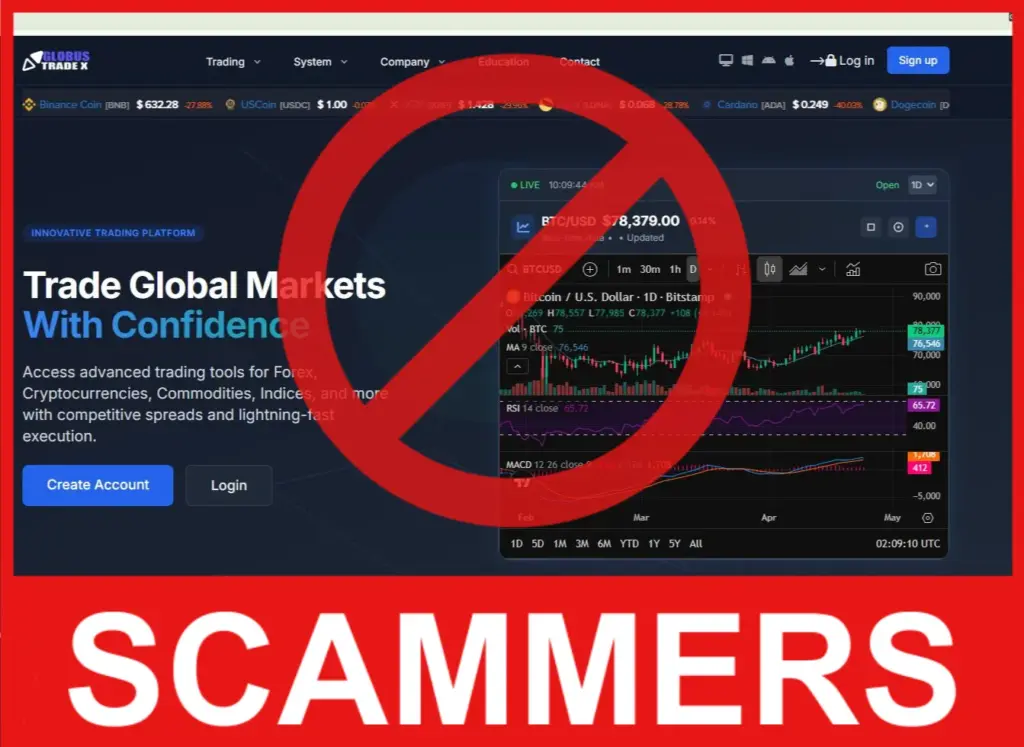
Information About the Fraudulent Broker
Globus Trade X presents itself as an international trading broker offering access to global financial markets. On its website, it advertises trading in forex pairs, cryptocurrencies, commodities, and indices. The platform claims to provide advanced trading tools, professional analytics, and “high-profit opportunities.” However, users report that most of these promises remain only on paper. After registration, clients are usually contacted by so-called “account managers” who push them to deposit increasingly larger amounts of money. The communication is often aggressive, with repeated calls encouraging quick investment decisions. Many traders describe the platform interface as basic and lacking transparency. There is little information about trading conditions, spreads, leverage, or execution model. Instead, the focus is placed heavily on deposits and upgrading account tiers. Another concerning aspect is the marketing strategy. Globus Trade X allegedly uses online ads, social media promotions, and unsolicited messages to attract inexperienced traders. The messaging is often centered around financial independence and quick earnings, which is a common tactic in questionable brokerage schemes.
Verification of Company Data
One of the strongest warning signs regarding Globus Trade X is the lack of verifiable corporate information. A legitimate brokerage company is usually registered with a financial regulator, such as the FCA (UK), CySEC (Cyprus), or ASIC (Australia). It also provides clear details about its legal entity, license number, and physical office location. In the case of Globus Trade X, this information appears either missing or inconsistent. The website does not clearly confirm a valid financial license, and there is no reliable proof that the company is authorized to provide brokerage services in regulated jurisdictions. Another issue is domain anonymity. Many users note that ownership details of the website are hidden or unclear. This is often done using privacy protection services, which is not illegal by itself but is frequently used by unregulated brokers to avoid accountability. Additionally, corporate documentation such as company registration certificates, regulatory numbers, or audit reports is either absent or not verifiable through official databases. This lack of transparency makes it extremely difficult for clients to confirm who is actually operating the platform. For experienced analysts, these gaps in corporate data are a strong signal that the broker may not be operating under proper financial supervision.
Exposing the Broker as a Fraudster
When analyzing Globus Trade X, several warning signs commonly associated with scam brokers become visible. First, there is the issue of withdrawal problems. Many users report that after making profits or even just trying to withdraw their initial deposit, they encounter delays, rejection requests, or complete account blockage. Second, there is a strong pattern of pressure-based communication. Account managers allegedly push clients to deposit more funds, often claiming that larger investments will unlock higher profits or prevent account losses. This type of psychological pressure is a well-known tactic in fraudulent schemes. Third, the trading results shown on the platform may not reflect real market conditions. Some victims report sudden losses or manipulated trades that they did not execute themselves. Another important red flag is the lack of independent regulation. Without oversight from a financial authority, clients have no external protection if disputes arise. Finally, the platform structure itself appears designed to keep users inside the system while making it difficult to exit with funds. Combined, these elements strongly suggest a high-risk or potentially fraudulent operation.
Fraud Broker’s Deception Scheme
The operational model described by many users follows a familiar pattern seen in many online trading scams. It typically begins with online advertising or cold outreach. Once a potential victim registers, they are quickly contacted by a “personal advisor.” This person builds trust, sometimes even offering small initial profits to encourage further investment. Next comes the deposit escalation phase. Clients are persuaded to invest more money, often being told they are close to significant profits or trading opportunities. Emotional manipulation plays a key role here. Once the client has deposited a substantial amount, the situation changes. Withdrawals become difficult or impossible. The platform may introduce additional “verification steps,” request unexpected fees, or simply stop responding. In some cases, users report being shown fake trading profits on their dashboards to maintain the illusion of success. However, these numbers cannot be converted into real withdrawable funds. Eventually, communication breaks down entirely, leaving the victim locked out of their money.
How to Get Money Back from a Scam Broker
Victims of suspicious brokers like Globus Trade X should not attempt to handle recovery alone. Financial fraud cases are complex and require structured legal action. DNB Forex Review specializes in assisting clients who have lost money to unregulated or fraudulent brokers. The recovery process usually includes several steps. Analysis of transaction history and communication with the broker. Identification of payment methods used (card payments, crypto transfers, bank wires). Preparation of chargeback or dispute claims where applicable. Cooperation with financial institutions to challenge unauthorized transactions. Legal pressure where necessary to initiate recovery procedures. In many cases, time is critical. The sooner action is taken, the higher the chance of recovering at least part of the lost funds. DNB Forex Review experts help clients understand what options are available based on their specific situation and guide them through each stage.
Negative Reviews About the Broker
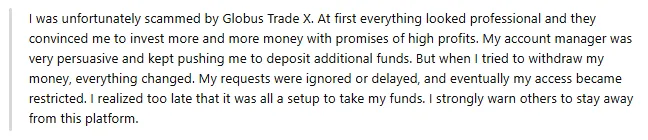
Although official reviews of Globus Trade X are limited, discussions across online forums and complaint boards show a concerning pattern. Users frequently describe similar experiences: initial friendliness from support staff, followed by increasing pressure to invest more money. After deposits are made, communication reportedly becomes more difficult. Many complaints focus on withdrawal issues. Some users claim that their requests were ignored for weeks, while others report being told to pay additional “taxes” or “fees” before funds could be released. There are also mentions of account restrictions without clear explanation. In some cases, traders say their accounts were suddenly disabled after requesting withdrawals. While individual stories vary, the overall pattern is consistent with platforms that operate without proper financial oversight.
Additional Risks and What Most People Overlook
One important aspect that many victims only realize too late is the psychological design of such platforms. Globus Trade X, like many similar brokers, appears structured to build emotional dependence. Clients are often assigned a “manager” who communicates frequently, creating a sense of personal attention. This relationship is used to build trust and reduce skepticism. Another overlooked factor is the use of fake urgency. Clients are often told that opportunities are “limited” or that markets are about to move dramatically, pushing them into rushed decisions. Additionally, some platforms use simulated dashboards that mimic real trading environments but do not connect to actual markets. This means that profits shown on screen may not exist in reality. Understanding these hidden mechanisms is crucial for recognizing how deeply such schemes are designed to influence behavior rather than provide real trading services.
Conclusion
When dealing with platforms like Globus Trade X, the most dangerous mistake victims make is waiting too long. At first, many people assume that withdrawal delays are just “technical issues” or temporary verification procedures. Scammers often rely on this reaction. They intentionally stretch communication, delay responses, and give vague explanations so that the client stays calm and keeps waiting instead of taking action. In reality, time works against the victim. The longer the delay continues, the harder it becomes to recover funds. Fraudulent brokers often move money quickly through multiple payment channels, including offshore accounts, crypto wallets, and intermediary processors. Once the funds are dispersed, tracing them becomes significantly more complicated. Another serious issue is the psychological pressure victims experience. Many clients feel embarrassed or unsure whether they were actually scammed. This hesitation is exactly what fraud schemes rely on. People delay seeking help, hoping the broker will eventually “fix the issue,” but in most cases, the situation only gets worse. There is also the risk of repeated targeting. Victims of one scam broker are often later contacted by so-called “recovery companies” that promise guaranteed fund returns for an upfront fee. These are often secondary scams designed to exploit already affected individuals. This makes it even more important to work only with verified legal professionals like DNB Forex Review, who operate transparently and do not promise unrealistic guarantees. From a practical standpoint, immediate action increases the chances of success in several ways. First, payment disputes such as chargebacks or bank complaints usually have strict time limits. If too much time passes, banks may no longer accept claims. Second, early documentation—screenshots, emails, transaction records—plays a critical role in building a strong case. Over time, access to account data or communication history may be lost or deleted. It is also important to understand that scammers often adjust their behavior once they sense pressure from legal action. In some cases, once victims involve professionals or start formal disputes, brokers may suddenly reappear and offer partial refunds or settlement attempts. This is not generosity—it is a reaction to potential legal risk. Another key reason to act quickly is emotional recovery. Many victims go through stress, frustration, and self-blame. Taking structured action with professionals helps regain control of the situation. Instead of feeling trapped or confused, the victim begins to understand the real options available and the steps needed to respond effectively. The main message is simple: in cases involving suspicious brokers like Globus Trade X, hesitation is costly. The financial system does not pause, and fraud networks do not wait. Every day of delay can reduce the chances of tracing funds or building a successful claim. This is why contacting specialists such as DNB Forex Review immediately after suspicion arises is not just recommended—it is often critical. Their role is to analyze the situation quickly, identify the payment paths, and initiate recovery strategies while they are still legally and technically possible. In conclusion, Globus Trade X demonstrates many characteristics associated with high-risk and potentially fraudulent brokerage activity. For anyone affected, the priority should not be waiting for explanations, but taking fast, informed action. The sooner the response begins, the higher the likelihood of limiting damage and possibly recovering lost funds.






Reading the experiences of other victims of Globus Trade X sounds very familiar. In my situation, withdrawals were always delayed with explanations involving compliance checks, tax obligations, and account verification procedures. Every time one requirement was completed, another appeared. Eventually it became clear that the company was more interested in obtaining additional payments than processing withdrawals. I am now considering professional assistance to investigate possible recovery options. If someone has experience dealing with similar investment scams and knows what documents are most important to prepare, I would be grateful for any recommendations.
Specialists will contact you after you submit a request on our website.