When someone lands on an online trading platform with a slick design and promises of easy profits, it can feel exciting at first. The idea of generating income through forex, cryptocurrencies, or other financial instruments seems like a modern way to build wealth. But not all platforms that claim to be brokers are legitimate. Some operate in ways that deceive investors and make it extremely difficult to withdraw funds once they are deposited. One such platform that has drawn widespread concern is Primostratique. This review is written for anyone who might be considering investing through this platform or anyone who has already done so and now faces problems getting their money back. Our goal is to expose the signs of deception, to explain why Primostratique raises serious red flags, to discuss what real data is available, and to guide affected clients toward legitimate methods of recovering funds with professional help. This is not marketing or speculation. This is a focused, direct analysis based on publicly available information and real user complaints.
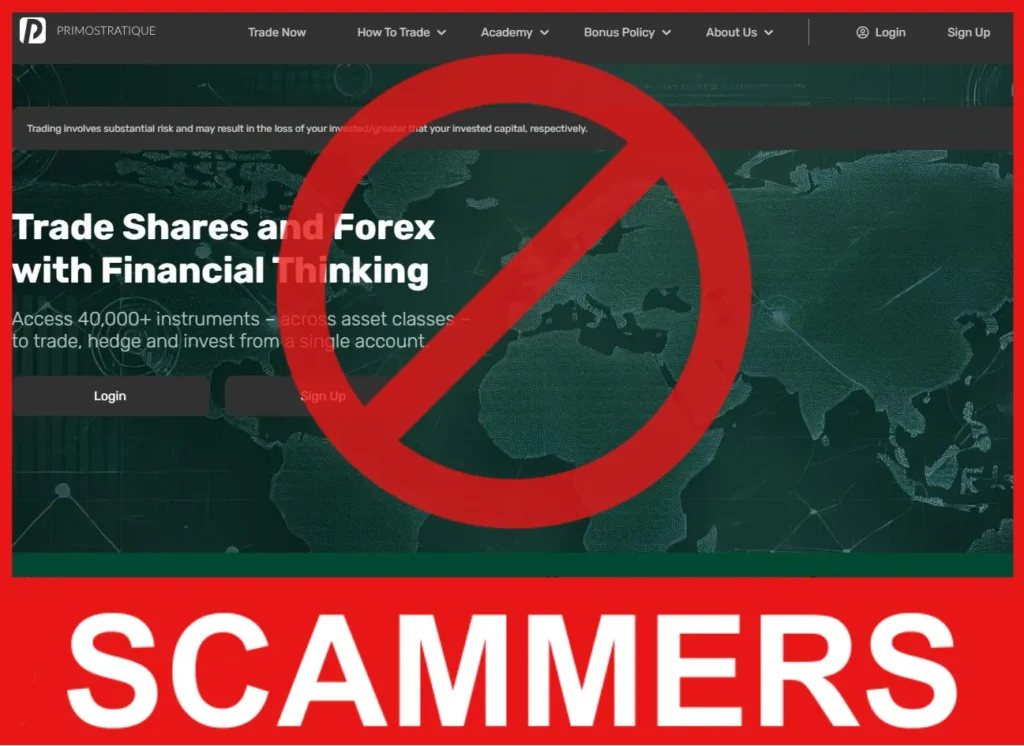
Information About the Fraudulent Broker
Primostratique presents itself as a global broker offering services in forex trading, cryptocurrency and leveraged trading, and a variety of financial products. On the surface, their website includes polished graphics, descriptions of different trading instruments, and claims about advanced trading tools. The platform also talks about client support, different account types, and features that might attract traders of various levels. However, below this surface layer, there are significant concerns about the legitimacy and transparency of the operation. The domain for Primostratique was registered relatively recently and does not have the long history one would expect of a reputable broker. The registration details are hidden behind a privacy service, making it impossible to reliably identify who actually owns or runs the company. This is often a red flag because legitimate brokers are required to show clear corporate and licensing information so clients can verify who they are dealing with. Independent checks of official regulatory lists, such as the register of the UK’s Financial Conduct Authority, show no record of Primostratique being licensed or authorized to operate as a financial services provider. Without such licensing, a company cannot legally offer trading services in most countries. The absence of verified regulatory registration suggests that Primostratique is operating without proper oversight, meaning there is no regulatory body protecting the investors’ funds or ensuring fair conduct. Some review algorithms that evaluate website safety score Primostratique as having medium to low risk based on technical aspects like SSL certificates, but they still warn that the company identity is hidden and the traffic to the domain is low. This combination indicates that while the site might not be obviously malicious in the sense of malware or phishing, its credibility as a financial broker is very weak and should not be taken as confirmation of legitimacy.
Verification of Company Data
A key step in evaluating any broker is to verify its corporate identity and regulatory status. For legitimate brokers, this information is typically clear and publicly confirmed by independent bodies. With Primostratique, however, that clarity does not exist. Primostratique’s website does list a physical address and contact phone number, and there are claims in some user reviews about the company having been established years ago in certain countries. But independent checks of national regulatory registers do not corroborate those claims. In other words, when analysts searched through official financial watchdog lists for records of Primostratique, nothing was found. No licensing number, no compliance documents, no official authorization to offer financial trading services. This absence of regulatory information is a major issue. It suggests that the company may be making claims about registration or legitimacy that cannot be verified. Legitimate brokers know that their credibility depends on their licensing status and will make that information easy to find and confirm. Fraudulent operations, on the other hand, sometimes invent or exaggerate corporate details knowing that few investors will thoroughly verify them. At the same time, some review platforms show mixed user reviews for Primostratique, indicating a rating that falls in the middle of the scale. But those reviews are self‑reported, and a small number of positive comments does not offset the serious transparency issues. Positive online reviews, especially on platforms where the company can respond to or curate them, cannot be taken as proof of legitimacy when all official data points to the contrary. In summary, the company data that is claimed on the Primostratique site or in some user profiles does not match the verifiable records available from financial regulators, and that discrepancy alone should be enough to trigger suspicion for anyone considering using their services.
Exposing the Broker as a Fraudster
There are several distinct signs that, taken together, suggest Primostratique operates more like a fraudulent scheme than a legitimate broker. These signs go beyond mere skepticism and point to concrete issues that investors should be aware of. First, the lack of transparent regulatory status is itself a strong indicator. Real brokers must be licensed and must display those credentials prominently because their clients need to know that their funds are being held and managed under legal safeguards. Primostratique does not provide verifiable evidence of such oversight. Second, the ownership of the domain and company details is hidden. Legitimate financial institutions do not obscure their corporate identity behind privacy services. While privacy protection might be normal for small business websites, it is not normal for companies handling investor funds and providing financial services. Third, the way the platform describes its services often includes language that invites investors to believe in high returns and advanced tools without emphasizing the real risks of trading. Serious trading platforms always stress risk management and the possibility of losing money, because trading markets are inherently risky. Platforms designed to lure deposits often focus instead on profit possibilities with minimal realistic discussion of risk. Fourth, early user complaints indicate that some clients were asked to pay additional fees in order to “insure assets” or to process withdrawals. This type of advance fee request is a common tactic in fraudulent schemes: clients deposit initial funds, see supposed profits, and then find that they must pay additional costs before they can withdraw any of their money. Fifth, community discussions reveal people expressing concern about the company’s reliability, mentioning that it may be connected to older, known scam operations under different names. Such patterns of rebranding and continued operation under new identities are well documented in fraud circles. These practices, when viewed together, suggest that Primostratique has many of the hallmarks of a fraud scheme rather than a legitimate trading broker.
Fraud Broker’s Deception Scheme
Understanding the typical mechanics of online broker scams helps to make sense of how operations like Primostratique can take money from clients and keep it. These schemes follow a recognizable pattern. It starts with targeted marketing. Potential investors receive advertisements through social media, email outreach, messaging apps, or online ads promising easy access to trading and high returns. The platform presents itself as user‑friendly, with professional design and seemingly advanced technical features. Once someone registers, they are often contacted by an account manager. This person is trained to build trust, often highlighting small initial gains or promising exclusive opportunities if more funds are deposited. If a client only deposits a small amount at first, the platform may show fabricated profits to encourage additional investment. The next stage is where the issues begin. When the client attempts to withdraw funds — either the original deposit or any purported profits — they encounter obstacles. They may be told that verification is incomplete, that additional fees are required, or that “insurance” or “tax” payments must be made before withdrawal. At this point, the scam begins to reveal itself as client funds are effectively blocked. Behind the scenes, accounts may be frozen, communication may slow down or stop, and the platform may introduce technical or administrative excuses to delay payout indefinitely. Eventually, the site might shut down entirely, leaving clients with little recourse. These schemes depend on extracting as much money as possible before disappearing. They rely on psychological techniques that build confidence, then use urgency and fear of missing out to induce further deposits. Understanding this pattern makes it easier to recognize red flags before it’s too late.
How to Get Money Back from a Scam Broker
If you have already deposited funds with a suspicious broker such as Primostratique, the most important thing is not to panic — but to act strategically. Many investors wrongly assume that once money is lost, it cannot be recovered. That is not always the case. The first step is gathering evidence: screenshots of transactions, email conversations, account statements, deposit records, and any communication with the broker. The more documentation you have, the stronger your case. Next, contact your bank or payment provider immediately. If you made deposits via credit card, debit card, or a bank transfer, you may be able to initiate a chargeback request or dispute. Financial institutions have specific procedures for fraudulent or unauthorized transactions, and with the right documentation, you may recover all or part of your funds. At the same time, file formal complaints with local consumer protection agencies, financial regulators, or law enforcement authorities. Submission of complaints to the relevant authorities creates a public record and initiates official review processes. This is where professional services like DNB Forex Review can make a critical difference. Experts who specialize in dealing with fraudulent brokers understand the legal frameworks, the documentation required, and the channels that must be used to pursue recovery. They can assist with: Assessing whether a broker’s actions violate financial laws. Preparing and submitting disputes to banks and payment processors. Filing complaints with regulators and law enforcement. Providing legal representation if necessary. Offering ongoing support and communication with all parties involved. Recovery is often not fast, and in some cases may take months or longer. But with experienced professionals guiding the process, the likelihood of successful recovery is significantly higher than trying to navigate it alone.
Negative Reviews About the Broker
Public reviews of Primostratique are limited, but the available data reveals a concerning split between some positive testimonials and strong negative feedback. On general review platforms, a few users post high ratings, describing the platform as reliable or praising the trading interface. These positive reviews often appear alongside responses from the company itself thanking users for feedback. However, there are also direct complaints from users alleging attempted scams, that they were asked to pay money supposedly for asset insurance or other fees, and that withdrawal processes were problematic. One review specifically states that the company “has tried to scam me” with demands for additional payments before allowing access to funds. Independent discussion forums show even stronger skepticism. Individuals express that Primostratique may not be reliable, that it could be a rebranded version of older fraudulent brokers, and that connections to previously exposed scam operations have been mentioned. People warn about the absence of regulation, express concern about unverifiable claims, and caution others not to trust such platforms. These mixed but concerning experiences are a pattern often seen in scams: a few surface‑level positive comments that may be encouraged by the broker are present, but independent complaints and warnings from users show deeper issues. Legitimate platforms almost always have consistent user experiences supported by transparent operations; when user experiences vary wildly and official information is missing, that is a reason to be extremely cautious.

Additional Topic — How Rebranding and Evasive Tactics Work in Online Broker Scams
One aspect that is not often discussed but is important for investors to understand is how fraud operations attempt to evade detection by rebranding or changing identities. Scammers frequently use a strategy where they shut down one website, rebrand with a new name, and claim a new corporate identity while retaining the same backend operations and tactics. This method allows them to escape regulatory warnings, negative reviews, or legal scrutiny that have begun to accumulate under an old name. They can reuse the same payment processing systems, the same scripts for sales calls, and essentially continue the same deceptive practices under a new label. This tactic also complicates victims’ efforts to seek recovery. If someone deposited money with a broker under one name and later sees that broker reappear with a slightly different name, they may think the old issues do not apply. In reality, victims often discover too late that the “new” broker is connected to the same operators who defrauded investors before. It is especially important for investors to verify not only the current name of a trading platform but also its history. Searching for older versions of the company name, checking for reports of rebranding, and investigating whether previous complaints mention the same individuals or tactics can help reveal a pattern of deception. Understanding this rebranding strategy empowers investors to avoid repeated traps and to recognize that surface changes in branding do not guarantee legitimacy.
Conclusion
Primostratique exhibits multiple characteristics common to fraudulent online brokers. There is a lack of clear regulatory oversight, hidden ownership, unverifiable corporate claims, suspicious user reports about payment and withdrawal issues, and independent analysis suggesting that the platform is unlicensed and potentially linked to previous scam operations. These factors create a highly risky environment for investors. Trading always involves risk, but entrusting funds to an entity without transparent oversight and verifiable regulation is a risk that has led many people to lose significant amounts of money. If you have been affected by such a platform, immediate action is crucial. Gathering evidence, contacting financial institutions for chargeback or dispute procedures, filing complaints with appropriate authorities, and seeking assistance from professionals who specialize in broker fraud cases can vastly improve your chances of recovering some or all of your funds. Specialist firms like DNB Forex Review have the experience, legal knowledge, and documentation skills needed to navigate the complex process of fraud recovery. They can provide personalized support, help liaise with banks and regulators, and guide you through steps that might otherwise be overwhelming to handle on your own. In the world of online trading, not every platform is what it claims to be. Staying informed, recognizing the warning signs, and acting decisively when something feels wrong can protect your investments and empower you to make safer financial decisions. If you or someone you know has lost money through Primostratique or similar operations, reaching out for professional recovery support is one of the most important steps you can take.