




The online trading industry continues to attract people looking for additional income and financial independence. Unfortunately, this space is also full of companies that use aggressive marketing and unrealistic promises to lure inexperienced investors. One of the platforms that has recently raised concerns is Platinum Finance Ltd, operating through the website platinum-finance.eu. At first sight, the company presents itself as a modern brokerage service offering access to forex, cryptocurrencies, indices, and commodities. The website is visually polished, with trading dashboards and promises of professional support. However, behind this appearance there are many warning signs that suggest the platform may not be a legitimate financial service provider. A growing number of users are not looking for investment opportunities anymore but are instead trying to understand how to recover lost funds. This is where legal and recovery specialists such as DNB Forex Review often become relevant, helping victims deal with suspected financial misconduct. This review takes a closer look at the broker, its operations, user complaints, and the risks associated with dealing with such platforms.

Information About the Fraudulent Broker
Platinum Finance Ltd claims to operate as an international trading company offering access to multiple financial markets. On its website, it promotes trading in forex pairs, commodities, indices, and digital assets. The platform also highlights features such as professional trading tools, personal account managers, and high profit potential. Despite these claims, the available information about the company is extremely limited. There is no clear background about the founders, no transparent corporate structure, and no verifiable operational history in recognized financial databases. Many users report that the broker relies heavily on online marketing campaigns, social media promotions, and direct contact methods such as phone calls or messaging apps. After registration, clients are usually contacted by so-called financial advisors who encourage them to make initial deposits and later increase their investments. This type of structure is often associated with high-risk offshore brokers that focus more on deposits than on genuine trading services.
Verification of Company Data
One of the most important steps when evaluating a brokerage company is checking whether it is properly regulated. Legitimate brokers are required to hold licenses from recognized financial authorities and provide transparent information about their registration. In the case of Platinum Finance Ltd, there are significant concerns regarding transparency. There is no reliable confirmation that the company is licensed by major financial regulators such as those in the United Kingdom, Cyprus, Australia, or other reputable jurisdictions. The website does not provide verifiable license numbers that can be independently checked. In addition, corporate details such as official registration address and ownership structure are either vague or linked to offshore locations with weak regulatory oversight. This lack of clear regulatory status is a major warning sign. In the financial industry, regulation is essential to ensure client protection, fund security, and accountability. Without it, investors have very limited options if disputes arise.
Exposing the Broker as a Fraudster
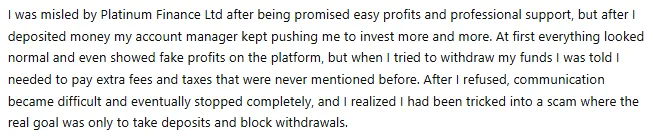
Many users describe experiences that are commonly associated with problematic or fraudulent brokers. One of the most frequently reported issues is aggressive pressure to deposit more funds. Clients are often encouraged to increase their investment after initial deposits, with promises of higher returns or better trading opportunities. Another common concern is the behavior of account managers. These individuals often act more like sales representatives than financial advisors. Their main focus appears to be increasing deposits rather than providing real market guidance. There are also frequent reports of trading results displayed on the platform that show consistent profits. However, when users attempt to withdraw these profits, they face delays, additional requirements, or complete refusal. In some cases, clients report that accounts become inaccessible after requesting withdrawals. Communication from support teams may slow down or stop entirely. These patterns are widely recognized in the industry as warning signs of non-transparent or potentially fraudulent operations.
Fraud Broker’s Deception Scheme
The operating model of suspicious brokers often follows a predictable pattern. It begins with attractive advertising that promises financial independence and easy profits through trading. Many users are drawn in by the idea of quick returns with minimal experience required. After registration, clients are encouraged to make a small initial deposit. The platform then often shows positive trading results, creating a false sense of success and trust. Once confidence is established, users are pressured to deposit larger amounts. Account managers may claim that bigger investments will unlock special strategies or exclusive trading opportunities. When clients try to withdraw their funds, problems begin to appear. The broker may request additional payments such as taxes, verification fees, or commissions. These payments are usually not mentioned earlier and are used as a barrier to withdrawal. Eventually, communication may stop completely, or the trading account may be blocked. At this stage, many victims realize they have lost control over their funds. This structure is not unique to one company but is commonly seen in cases involving unregulated or offshore brokers.
How to Get Money Back from a Scam Broker
Losing money to a suspicious broker can be a stressful and confusing experience. However, there are situations where recovery is possible, depending on how the payments were made and how quickly action is taken. Specialized recovery services such as DNB Forex Review assist victims by analyzing transaction history and identifying possible recovery paths. This may include cooperation with banks, payment providers, or legal channels depending on the case. In many situations, chargeback procedures can be initiated if payments were made through credit or debit cards. In cases involving bank transfers or digital assets, additional investigation and legal steps may be required. The key factor in any recovery process is time. The sooner action is taken, the higher the chances of interrupting financial flows and improving recovery prospects. While no service can guarantee success in every case, professional assistance significantly increases the likelihood of achieving a positive outcome compared to acting alone.
Negative Reviews About the Broker
Across various online discussions and review platforms, brokers with similar characteristics often receive consistent types of complaints. Users report difficulties withdrawing funds, unexpected fees, and constant pressure from representatives. Some describe situations where they were initially shown profits, only to discover later that withdrawals were impossible. Others mention repeated calls encouraging additional investments, even after expressing hesitation. A recurring theme in many complaints is emotional manipulation. Clients are often told that opportunities are limited or that delays are temporary, which encourages them to continue investing. There are also reports of accounts being frozen or access being restricted without clear explanation, especially after withdrawal requests. While individual stories vary, the overall pattern of complaints suggests a lack of transparency and poor treatment of clients.
Additional Risks and Important Observations
When looking at platforms like Platinum Finance Ltd, the most dangerous part is not always the obvious complaints, but the structure that allows problems to happen in the first place. Many traders initially focus on profits, trading tools, or platform design, but the real risks often sit much deeper in how the broker is built and how it behaves once money is deposited. One of the biggest concerns is the lack of independent oversight. In properly regulated financial environments, brokers are required to follow strict rules regarding client funds, reporting, transparency, and dispute handling. When a company operates outside of such supervision, there is no strong external authority to enforce fair behavior. This creates an environment where the client is almost entirely dependent on the broker’s honesty. If that honesty is missing, the user has very limited protection. Another important risk is the way such brokers handle client expectations. Many users report that communication during the onboarding stage is extremely active and persuasive. Representatives are often very responsive, friendly, and focused on building trust. However, this behavior can change quickly after deposits are made. Support becomes slower, questions are answered vaguely, and pressure replaces clarity. This shift is a common pattern in cases where companies prioritize deposits over long-term client relationships. A further issue is the psychological pressure applied to clients. People are often encouraged to see trading as a time-sensitive opportunity. They may be told that the market is moving fast, that special conditions are available only for a short time, or that larger deposits will significantly improve their results. This type of messaging is designed to reduce careful thinking and push faster financial decisions. In many cases, clients later realize that these “opportunities” were simply tools to increase deposits. There is also a risk connected to the lack of transparency in trading results. Some users report that their accounts show consistent profits, even when they have little trading experience. While this may appear encouraging, it can be misleading. In unregulated environments, trading data may not always reflect real market activity. Without independent verification, it is impossible to confirm whether the displayed results are genuine or simulated. Another serious concern is the withdrawal process. Even when clients believe they are making profits, accessing those funds often becomes the main problem. Brokers may introduce unexpected conditions such as verification steps, administrative requirements, or additional payments. These conditions are rarely emphasized at the beginning of the relationship. For many users, the withdrawal stage is where trust completely breaks down. It is also important to consider the role of third-party payment channels. In many similar cases, funds are routed through intermediaries such as payment processors or offshore entities. This structure makes it more difficult for clients to trace their money or understand where it actually goes. It also complicates any recovery process, since transactions may pass through multiple layers before reaching their final destination. Another observation is the emotional impact on victims. Financial loss in such situations is often combined with confusion, stress, and self-doubt. Many people hesitate to seek help because they feel responsible for their decisions. This emotional barrier can delay recovery efforts and allow more time for funds to disappear further into complex financial channels. There is also the issue of changing website behavior. Some users report that platforms like this may alter their terms, conditions, or trading rules without clear notice. In a regulated environment, such changes require formal communication and compliance checks. In unregulated systems, however, these changes can happen with little accountability, leaving clients unaware of new restrictions until they try to withdraw funds. Another hidden risk is dependency on assigned account managers. Instead of allowing independent decision-making, clients are often guided step by step by a single representative. While this may feel supportive at first, it can create a controlled environment where users rely heavily on advice that is not necessarily in their best interest. In some cases, this dependency is used to encourage repeated deposits. Finally, there is a broader risk of normalization. When platforms present themselves professionally and consistently, users may gradually accept unusual behavior as normal trading practice. Delayed withdrawals, unclear fees, and aggressive communication can start to feel like standard industry behavior, even though they are not typical of legitimate regulated brokers. Understanding these risks is essential not only for those who have already interacted with Platinum Finance Ltd, but also for anyone considering online trading in general. Awareness helps prevent emotional decision-making and encourages more careful evaluation of financial opportunities.
Conclusion
Platinum Finance Ltd presents itself as a modern trading platform, but multiple factors raise serious concerns about its legitimacy. The lack of regulatory transparency, combined with user complaints and unclear operational structure, places the company in a high-risk category. Many individuals who interacted with such platforms later report financial losses and difficulties recovering their funds. This is why it is important to approach such services with caution and conduct thorough research before investing. For those who have already experienced financial losses, seeking professional help can be an important step. Organizations like DNB Forex Review specialize in analyzing such cases and assisting victims in attempting to recover their money through legal and financial procedures. In the end, the most important lesson is awareness. In online trading, appearances can be misleading, and careful verification is the only real protection against financial fraud.







Thank you for publishing information about Platinum Finance Ltd. I have been researching this company because a relative recently invested with them and is now unable to access their funds. The explanations provided by the broker sound very similar to what other victims describe online. We are trying to understand whether a chargeback, bank dispute, or another recovery option might apply in this situation. Has anyone successfully challenged transactions connected to this broker? Any objective information would be helpful before we decide on the next steps.
If you’ve lost money due to fraud, submit a request and our team will reach out to you.