




The online trading industry has become one of the easiest places for fraudulent projects to hide behind professional-looking websites and promises of fast profits. Supa Trade, operating through supatradepro.net, is one of those platforms that has started attracting attention for all the wrong reasons. On the surface, it presents itself as a modern brokerage offering access to Forex, cryptocurrencies, and CFDs with attractive trading conditions. The presentation looks convincing enough for inexperienced traders, which is exactly what makes such platforms dangerous. However, when you look beyond the marketing language, a very different picture begins to appear. Numerous users describe a pattern of behavior that does not align with legitimate financial services. Instead of stable trading conditions and transparent operations, people report aggressive persuasion to deposit money, unclear company details, and serious problems when trying to withdraw funds. This combination of factors has led many observers to question whether Supa Trade is a genuine broker or part of a broader scam structure targeting retail traders. This article is prepared in the context of investor protection and focuses on exposing the risks associated with Supa Trade. It also explains how victims can seek help through specialists experienced in financial fraud recovery, including teams such as DNB Forex Review.
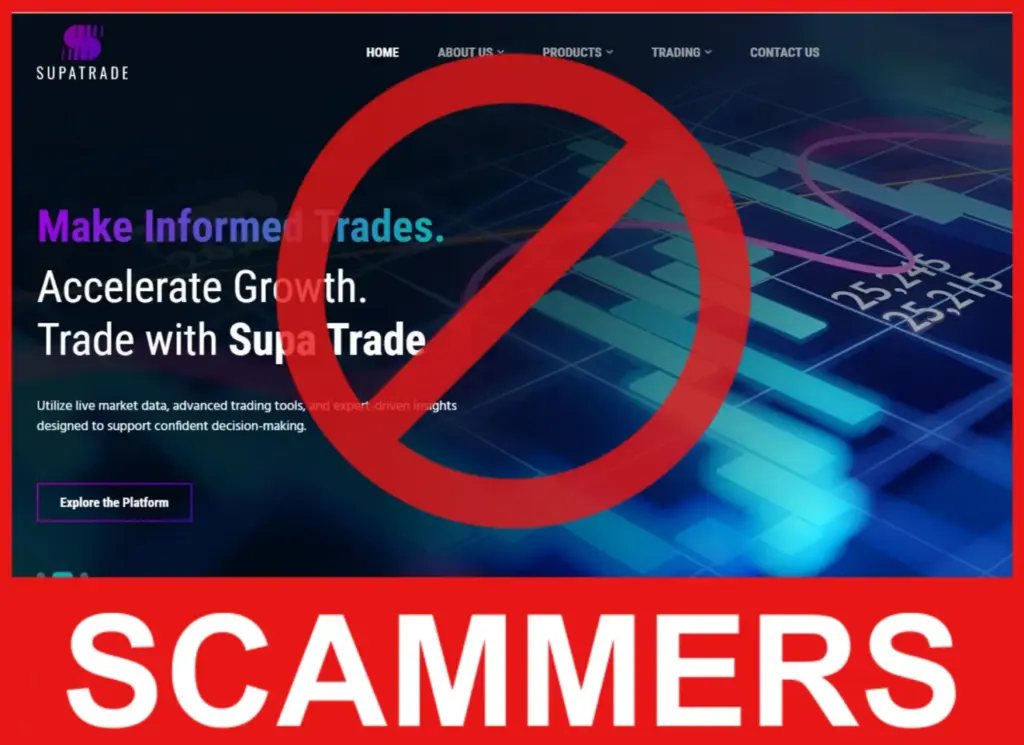
Information About the Fraudulent Broker
Supa Trade claims to operate as an international trading broker offering access to multiple financial markets. The website is designed in a way that mimics legitimate investment companies, with dashboards showing trading charts, account balances, and profit statistics. At first glance, everything appears professional and structured. The actual experience described by many users tells a different story. After registration, individuals are often contacted by so-called account managers who encourage them to fund their accounts quickly. These conversations are usually very persuasive, with promises of fast earnings, guaranteed returns, or exclusive trading opportunities that supposedly reduce risk. Once money is deposited, users often notice that their account balance begins to grow rapidly inside the platform. This creates the impression that trading is successful. However, this growth is frequently described as artificial and not linked to real market activity. When users attempt to withdraw funds, the situation changes. Requests are delayed, additional conditions appear, or clients are told they must pay extra fees before accessing their money. Many people report that communication becomes increasingly difficult over time. Support stops responding or provides vague explanations that never lead to actual withdrawals. In some cases, accounts are suddenly blocked after clients refuse to deposit more funds. This behavior is consistent with patterns seen in fraudulent brokerage operations.
Verification of Company Data
One of the most concerning aspects of Supa Trade is the lack of verifiable company information. Legitimate brokers are expected to operate under strict financial regulations, hold licenses from recognized authorities, and clearly display corporate details such as registration numbers, physical addresses, and regulatory oversight. In the case of Supa Trade, this level of transparency is missing. There is no clearly confirmed regulatory license from any reputable financial authority. The company identity behind the platform remains unclear, and there is little reliable information about who actually controls client funds or where the business is legally registered. This lack of transparency is a significant warning sign. In many fraudulent schemes, companies either hide their real ownership structure or provide misleading information that cannot be verified through official databases. This makes it extremely difficult for clients to take legal action or recover funds through standard financial channels. Another issue is the short lifespan of similar websites. Platforms like this often appear suddenly, operate for a limited time, and then disappear or rebrand under a different name. This cycle allows operators to avoid long-term accountability while continuing to attract new victims.
Exposing the Broker as a Fraudster
Several behavioral patterns associated with Supa Trade strongly resemble known online investment scams. One of the most common signs is the pressure placed on users to deposit money quickly. Instead of allowing clients to make independent decisions, representatives push for immediate funding, often using emotional or financial pressure tactics. Another major warning sign is the promise of unrealistic profits. No legitimate broker can guarantee fixed returns or risk-free trading outcomes. However, users report being told that large profits are easily achievable with minimal effort or that special strategies can eliminate losses. These claims are not consistent with real market behavior. Withdrawal issues are another recurring problem. Many users state that they are unable to access their funds once they request a payout. The reasons given are often vague and constantly changing. Some clients are told to pay additional fees, while others are asked to verify their identity repeatedly without resolution. There are also reports of account manipulation. Some traders believe that the trading environment is controlled in a way that causes unexpected losses or prevents successful withdrawals. While this is difficult to prove technically, the number of similar complaints raises serious concerns. Customer support behavior also follows a suspicious pattern. Communication is strong at the beginning when deposits are encouraged, but weak or nonexistent once clients request withdrawals or question the system.
Fraud Broker’s Deception Scheme
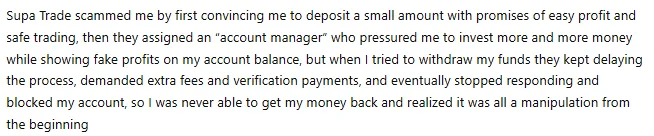
The operational model associated with Supa Trade follows a pattern commonly seen in fraudulent broker schemes. It usually begins with attracting potential clients through advertising or direct contact. Individuals are encouraged to open an account with a small initial deposit, which is presented as a low-risk entry into trading. After the initial deposit, the user is assigned a so-called personal advisor. This person builds trust and encourages additional investments. The trading platform shows growing profits, which creates confidence and motivates larger deposits. As investments increase, users are often encouraged to invest even more money, sometimes under the promise of better trading conditions or higher returns. In many cases, people are pushed to invest beyond their financial comfort level. When a withdrawal is requested, the system begins to change. New conditions appear, including taxes, verification fees, or account upgrades. Each step is designed to delay or prevent the return of funds while extracting additional payments. Eventually, communication stops entirely. Accounts may be blocked, and access to the platform may be restricted. At this stage, victims realize that recovering their money will require external assistance.
How to Get Money Back from a Scam Broker
For victims of platforms like Supa Trade, attempting to recover funds alone is often extremely difficult. Fraudulent brokers are designed to operate outside normal financial protection systems, which makes direct resolution unlikely. This is where specialized recovery services become important. DNB Forex Review works with cases involving financial fraud and broker disputes, helping victims analyze their situation and identify possible recovery methods. The process typically begins with reviewing all available transaction records, communication history, and payment methods. Depending on how the funds were transferred, different recovery strategies may be used. Bank chargebacks can sometimes be initiated for card payments, while crypto transactions may require blockchain tracing and exchange cooperation. Legal complaints can also be prepared to apply pressure on payment processors or intermediaries involved in the transaction flow. In many cases, speed is crucial, as fraudulent operators often move funds quickly after receiving them. Victims are strongly advised not to send additional payments in hopes of unlocking withdrawals. This is one of the most common manipulation tactics used by scam brokers.
Negative Reviews About the Broker
Across online discussions, Supa Trade is frequently mentioned in a negative context. While experiences may vary, several patterns appear repeatedly in user reports. Many individuals describe initial positive communication followed by sudden problems once larger deposits are made. Withdrawal refusal is the most commonly reported issue. Users state that even small withdrawal requests are rejected or endlessly delayed. Another frequent complaint involves emotional pressure from account representatives. Users report being persuaded to continue investing under the fear of losing previous deposits or missing profit opportunities. This psychological pressure often leads to further financial losses. Some users also mention that account balances appear artificially inflated. Profits displayed on the platform cannot be withdrawn, suggesting that the trading environment may not reflect real market conditions. As complaints increase, communication tends to disappear entirely. Many users describe feeling ignored or blocked once they question the legitimacy of the platform.
Additional Context and Risk Awareness
Platforms like Supa Trade often rely on rapid setup and rebranding strategies. Once negative feedback becomes widespread, the website may shut down and reappear under a different name. This makes it difficult for victims to track operators or warn others effectively. Another key factor is the use of offshore registration, which limits regulatory oversight. Without strong financial supervision, users have little protection if disputes arise. Payment methods also play a role. Many such platforms prefer irreversible transfer systems, which makes recovery more complex. This is why prevention and early verification are essential before investing. Understanding these risks helps reduce exposure to similar schemes in the future. Any platform promising guaranteed returns or pressure-based investment decisions should be treated with caution.
Conclusion
When looking at Supa Trade as a whole, the picture that emerges is not one of a standard brokerage service, but rather a highly questionable operation that shows multiple characteristics commonly associated with financial fraud schemes. Even without relying on isolated complaints, the overall structure, behavior patterns, and lack of transparency create a consistent warning signal for anyone considering interaction with this platform. The most important issue is trust. In legitimate financial services, trust is built through regulation, clear corporate identity, verifiable licensing, and long-term reputation in the financial market. Supa Trade does not demonstrate these foundations in a convincing way. Instead, it relies heavily on presentation, marketing language, and persuasive communication tactics designed to create urgency and emotional pressure rather than informed decision-making. Another critical concern is the repeated reports of withdrawal obstruction. In any real brokerage environment, the ability to deposit and withdraw funds freely is fundamental. When users consistently describe delays, excuses, additional payment demands, or complete account restrictions once withdrawal is requested, it strongly indicates that the primary goal of the platform may not be trading at all, but rather accumulation of client deposits. This pattern alone is one of the strongest indicators of potential fraud in the online investment space. Equally important is the behavioral structure of communication. Many users describe a clear shift in tone after depositing money. At the beginning, communication is frequent, friendly, and highly persuasive. Once funds are secured, responsiveness decreases, and when clients begin asking for withdrawals, communication often becomes vague or disappears completely. This type of staged interaction is not typical of legitimate financial institutions, which maintain consistent support regardless of account activity. The psychological manipulation reported by users also deserves attention. Promises of guaranteed profit, pressure to reinvest, fear-based messaging about losing opportunities, and suggestions to deposit more money to “unlock” profits are all tactics designed to override rational financial decision-making. These methods are widely recognized in scam brokerage models and are especially effective against inexperienced traders who may not be familiar with real market risks. Another broader concern is sustainability. Platforms operating in this manner rarely remain stable for long periods. They often function for a limited time, accumulate deposits, and then either disappear or rebrand under a different name. This creates a cycle where new victims are continuously targeted while previous complaints become harder to trace. The lack of accountability makes recovery even more difficult once funds are lost. From a legal perspective, the absence of verified regulatory oversight significantly increases risk. Without supervision from a recognized financial authority, clients have no guaranteed protection mechanisms. This means disputes cannot be resolved through standard investor compensation systems, leaving victims dependent on specialized recovery approaches. It is also important to highlight the emotional impact on victims. Financial loss in such cases is often accompanied by stress, confusion, and a sense of betrayal. Many individuals initially believe they are participating in legitimate trading activity and only realize the situation after repeated failed withdrawal attempts. By that time, significant financial damage may already have occurred. Taking all of this into account, Supa Trade presents itself as a high-risk platform with multiple red flags that should not be ignored. While each individual warning sign might be dismissed in isolation, the combination of aggressive marketing, unclear ownership, withdrawal problems, and user complaints forms a strong pattern that aligns with known fraudulent broker behavior. For anyone already affected, time becomes a crucial factor. The sooner action is taken, the higher the chances of tracing funds or initiating recovery procedures. Waiting too long often results in lost opportunities for chargebacks or legal intervention, as funds may be moved through multiple channels. This is why professional assistance becomes important in such situations. Specialized teams experienced in financial fraud cases can analyze transaction flows, identify possible recovery routes, and communicate with relevant financial institutions. In many cases, victims are not aware of the full range of options available to them, especially when dealing with cross-border or crypto-related transactions. Ultimately, the most important lesson from cases like Supa Trade is the necessity of caution in online investing. Any platform that guarantees profits, pressures quick deposits, or makes withdrawals complicated should be treated with skepticism. Real financial markets do not operate on certainty or urgency, and legitimate brokers do not need to pressure clients into repeated deposits. In conclusion, Supa Trade should be approached with extreme caution based on the overall pattern of behavior and reported experiences. The risks significantly outweigh any potential benefits, and users should prioritize protecting their funds and verifying all financial platforms before engaging in any form of investment activity.








I’m trying to understand what options exist after being misled by Supa Trade representatives. They presented it as a low-risk investment platform, but after deposits increased, withdrawal requests were ignored. I’m now looking into chargeback possibilities and legal recovery routes. If anyone has gone through this specific platform case, what approach worked better—bank dispute procedures or formal recovery services? Any guidance on realistic expectations would be helpful before I proceed further.
Leave a request, and our team will help you find the best solution.