




Online trading platforms appear every year, each one promising simple access to global financial markets, fast profits, and professional assistance. Among these websites is CP Group, operating through cp-group.cc. At first sight, it positions itself as a modern brokerage offering forex, commodities, indices, and cryptocurrency trading. The platform highlights easy conditions and attractive earning potential, which can quickly catch the attention of beginners who are new to trading. In reality, the online trading sector is full of cases where the outward presentation does not match the actual operation. Many users who later try to verify such companies often discover that important details are either missing or impossible to confirm. This analysis takes a closer look at CP Group, focusing on transparency, structure, and common risk indicators seen in similar platforms, as well as explaining how recovery support services like DNB Forex Review may become relevant when financial disputes occur.
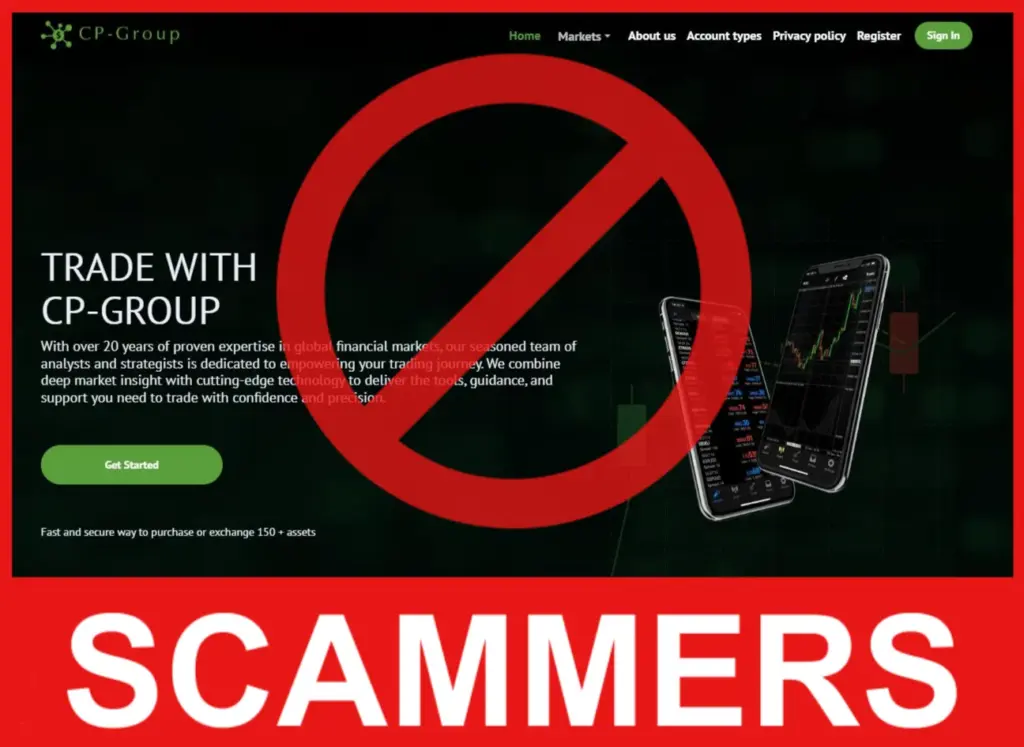
Information About the Fraudulent Broker
CP Group describes itself as an international financial service provider offering access to multiple markets through an online trading system. The platform promotes fast order execution, advanced trading tools, and dedicated support, creating the impression of a professional brokerage environment. However, a deeper look reveals that key operational details are not clearly presented. Established brokerage companies normally disclose full corporate identities, regulatory licenses, and verifiable office locations. In this case, such information is either incomplete or difficult to independently confirm. Another noticeable aspect is the emphasis on promotional language rather than technical or regulatory clarity. The focus is placed on profit opportunities and trading simplicity, while risk disclosure and legal transparency are not equally highlighted. In legitimate financial markets, brokers are required to clearly state that trading involves risk and that profits are never guaranteed. User communication is often structured around account representatives who actively encourage deposits and trading activity. Instead of neutral advisory support, interactions may be driven by sales-oriented motivation, a pattern frequently observed in higher-risk or unregulated trading environments.
Verification of Company Data
Regulation is one of the most important factors when evaluating any financial platform. Licensed brokers must operate under strict supervision, follow client protection rules, and maintain transparent reporting standards. In the case of CP Group, there is no clear, verifiable confirmation that it is regulated by a recognized financial authority in major jurisdictions. This lack of confirmed licensing immediately raises the risk level for potential users. Another issue often associated with similar platforms is hidden domain ownership. While privacy protection services are common online, in the financial sector they can reduce accountability and make it difficult to identify who is actually operating the business. Legitimate financial companies typically provide clear corporate records that can be verified through official regulatory databases. There is also inconsistency in corporate information presentation. Some details may be vague or incomplete, making it impossible to independently confirm the company’s legal structure. In financial services, this lack of traceability is considered a serious warning sign because it limits legal recourse in case of disputes.
Exposing the Broker as a Fraudster
Platforms with similar profiles often demonstrate recurring behavioral patterns that raise concern. One of the most common is aggressive client acquisition, where users are frequently contacted and encouraged to increase deposits with promises of improved trading results. Another issue is the use of unrealistic expectations. Some platforms imply stable or even guaranteed profits, which does not reflect real financial market conditions where losses are always possible. It is also common for users to report that account balances initially show positive growth. This early performance can create a false sense of trust and encourage further deposits. However, when withdrawal requests are made, users may encounter delays, additional verification demands, or unexpected financial conditions. In many cases across the industry, these combined patterns are considered strong indicators of high operational risk and potential financial misconduct.
Fraud Broker’s Deception Scheme
The structure of these platforms often follows a predictable pattern. Users are initially attracted through online advertising or direct contact and guided to register an account. After registration, they are encouraged to make an initial deposit, often presented as a low-risk entry point. Once funds are deposited, the platform typically shifts focus toward encouraging further investment. Account managers may suggest trades, provide guidance, or display early profits to build confidence in the system. As trust increases, users are often pushed to deposit larger amounts. This stage usually involves promises of higher returns, premium account benefits, or exclusive trading opportunities. Difficulties usually arise when users attempt to withdraw funds. At this point, obstacles such as administrative delays, additional verification requirements, or requests for extra payments may appear. In many reported cases across the industry, these barriers result in prolonged delays or complete inability to access funds.
How to Get Money Back from a Scam Broker
When disputes arise with unregulated or questionable brokers, recovering funds can be complex but not always impossible. The outcome depends on the payment method used, transaction history, and available documentation. Specialized recovery services like DNB Forex Review typically begin with a detailed case assessment. This includes reviewing payment records, communication logs, and account activity to determine the most effective recovery strategy. Depending on the circumstances, possible methods may include chargeback procedures for card payments, formal disputes through financial institutions, or tracing of transaction flows. In more complicated cases, cross-border legal actions or financial investigations may be necessary. Timing plays an important role in these cases. The sooner action is taken, the higher the likelihood of identifying recovery opportunities before funds become untraceable or irreversible.
Negative Reviews About the Broker
Across similar trading platforms, user feedback often follows consistent patterns. Many traders report problems when attempting to withdraw funds after initial positive results. Others describe persistent pressure from account representatives to increase deposits in order to access profits or improve account status. Another common complaint involves communication breakdowns after withdrawal requests are made. Support responses may become slow, unclear, or completely unavailable, leaving users uncertain about their financial situation. Some users also mention unexpected fees or conditions appearing only during withdrawal attempts. While experiences vary individually, repeated reports of similar issues across different platforms are a strong signal that should not be ignored.
Additional Risks Often Overlooked by Users
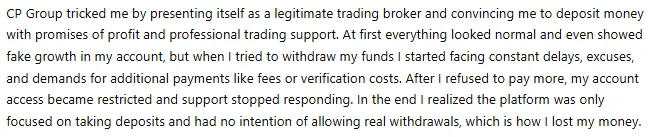
One of the biggest problems with platforms like CP Group is that many users focus only on the trading interface and potential profit, while ignoring the deeper structural risks that are not immediately visible. At the beginning everything looks simple: you deposit money, you see a trading dashboard, numbers move up and down, and it all feels like a normal financial service. But behind this surface layer there are several risk factors that are easy to miss, especially for people who are not experienced in financial markets. A major hidden risk is the lack of real separation between platform operations and client funds. In regulated environments, client money is usually kept in segregated accounts, meaning it cannot be freely used by the broker for operational purposes. In unregulated or unclear environments, there is no guarantee that such separation exists. This creates a situation where user deposits may be exposed to internal platform decisions without any external control or protection. Another often ignored issue is the way trading results are displayed. Many users assume that what they see on the screen reflects real market activity, but in some high-risk environments, the trading interface may not be fully connected to external liquidity providers. Instead, it can operate in a simulated or semi-controlled environment where results are influenced internally. For an inexperienced user, this is extremely difficult to detect, because everything visually resembles a real trading system. There is also a psychological manipulation layer that many users underestimate. Trading platforms of this type often create a gradual emotional dependency. It starts with small wins or positive account movements, which build confidence. Once trust is established, users become more comfortable increasing their deposits. This process does not feel forced; instead, it feels like natural progress. However, the structure behind it is designed to slowly increase financial exposure without triggering immediate suspicion. Another risk that is rarely considered is the absence of independent dispute resolution. In regulated financial markets, if a conflict arises between a client and a broker, there are external institutions that can review the case. In environments like CP Group, users often rely only on internal support channels. This creates a situation where the same entity that controls the funds also controls the communication about those funds, which significantly reduces fairness in conflict situations. A further overlooked factor is the complexity of payment routing. Many users assume they are simply depositing money into a trading account, but in reality funds may pass through multiple intermediaries, payment processors, or offshore entities. This layered structure makes it extremely difficult to trace money once it leaves the user’s original account. It also means that even identifying the final recipient can become a complicated technical and legal challenge. Another subtle but important risk is changing platform conditions. Users may notice that rules, fees, or requirements are not always consistent. In some cases, withdrawal conditions can change without clear explanation, or new requirements may appear only after a withdrawal request is submitted. This creates uncertainty and makes financial planning impossible, because the user cannot predict the actual cost or accessibility of their own funds. There is also the issue of information asymmetry. The platform has full control over what the user sees, including trading data, profit calculations, and account status updates. The user, on the other hand, has no independent way to verify whether this information reflects real market activity or internal calculations. This imbalance of information creates a dependency where the user must trust the platform completely without external verification. A frequently underestimated risk is emotional escalation. Many users do not plan to invest large amounts initially. They start with small deposits, often just to test the system. But as the platform shows early success or provides supportive communication, confidence increases. This emotional reinforcement can lead to progressively larger deposits, often without a clear decision point where the user consciously evaluates total exposure. Over time, this can result in financial commitments that were never originally intended. Finally, one of the most serious but least visible risks is the difficulty of reversing transactions once they are completed. Unlike traditional banking systems where disputes and chargebacks are structured and regulated, transfers to offshore or unverified entities can be extremely difficult to reverse. Many users only realize this limitation after problems appear, when it is already too late to use standard banking protection mechanisms effectively. All of these factors together create an environment where risk is not immediately obvious but builds up gradually. The most dangerous aspect is not a single event, but the combination of psychological influence, lack of transparency, and weak external oversight. Users often only understand the full picture when they try to withdraw funds or resolve a dispute, at which point the situation becomes significantly more complicated. This is why careful evaluation before investing is crucial. Once money enters such systems, the level of control decreases rapidly, and resolving issues becomes more about legal and technical processes rather than simple financial decisions.
Conclusion
Looking at CP Group as a whole, the most noticeable issue is the lack of clear and verifiable transparency. In financial services, transparency is not just a formality but a fundamental requirement that protects clients. Without confirmed regulation, clear corporate identity, and reliable oversight, users are left operating in an environment where accountability is limited. Another important observation is the imbalance between marketing promises and real-world trading conditions. Platforms that emphasize easy profits while downplaying risks create unrealistic expectations, especially for inexperienced users. In actual financial markets, uncertainty and losses are unavoidable, and any platform that does not reflect this reality in a balanced way should be viewed with caution. User interaction patterns also raise concerns. When communication is driven mainly by encouragement to deposit more funds rather than providing neutral financial guidance, it creates a situation where users may gradually move beyond their original investment intentions. This shift often leads to increased exposure and higher financial risk over time. Withdrawal behavior is another critical factor. In legitimate financial systems, withdrawals are processed clearly and without unnecessary conditions. When delays, additional fees, or unexpected requirements appear only at the withdrawal stage, it disrupts the basic trust structure between client and service provider. From a broader perspective, CP Group fits into a category of platforms where verification is limited and user protection is uncertain. This does not automatically confirm wrongdoing in every case, but it does indicate a higher level of risk compared to regulated financial institutions. It is also important to understand that financial disputes in such environments can quickly become complex. Funds may pass through multiple intermediaries, making recovery more difficult without professional assistance. This is where specialized services such as DNB Forex Review may help analyze the situation, explore possible recovery routes, and determine whether any legal or financial action can be taken. Ultimately, the key lesson is that caution and verification are essential before engaging with any trading platform. Once funds are deposited, control decreases significantly, and recovery becomes a structured legal process rather than a simple financial request. Careful evaluation, awareness of risk patterns, and skepticism toward unrealistic promises remain the strongest protection for any investor.









CP Group kept calling me every few days with new investment offers. They made everything sound safe and profitable. Now my account shows a good balance, but I can’t withdraw anything. They only ask for more money. I wish I had checked reviews before investing.
Leave your contact details, and we will get in touch with you for a free consultation.