




Crownex Capital Group is one of those broker brands that tries very hard to look polished. The website speaks the language of modern finance, promising easy access to trading, broad market choice, and a secure environment. It even gives the impression of a real London-based business. That presentation is exactly what makes such projects dangerous: the surface looks calm, but the structure underneath is often weak, unclear, or deliberately misleading. In this case, a public warning from BaFin already signals that the website is under official scrutiny, which is never a detail to ignore when money is involved.
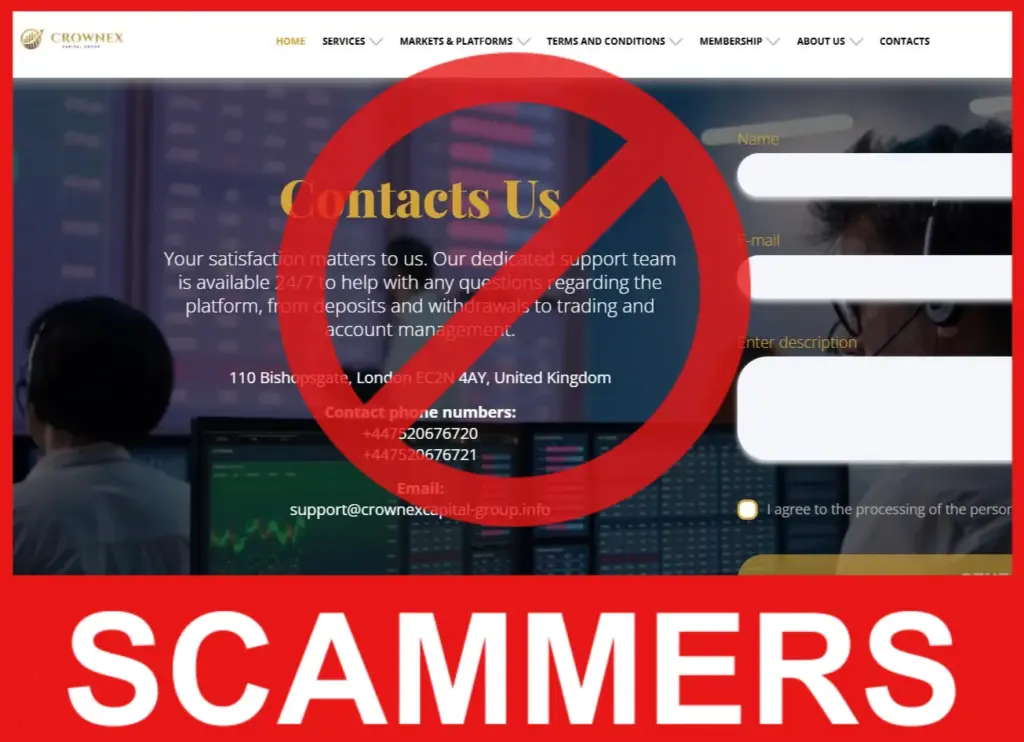
Information About the Fraudulent Broker
On its own site, Crownex Capital Group presents itself as a full-service trading company with account options, claims of tight spreads, and access to several asset classes. It also displays a London address and contact details to strengthen trust. This is a familiar tactic in online brokerage scams: use familiar financial language, borrow the look of legitimacy, and keep the visitor focused on the promise of profit rather than the proof of regulation. A broker that wants confidence should not need theatrical branding. It should be able to show clean, consistent, and verifiable corporate details.
Verification of Company Data
The company data around Crownex Capital Group is exactly where the trouble begins. The site supplies contact information, but outside checks do not make the picture any stronger. BaFin has issued a warning about crownexcapitalgroup.com, and that alone places the brand in a serious risk category for retail investors. Independent review material also says the broker’s regulatory story is unreliable, with claims that do not match the reality of what can be found on official registers. In simple terms, this is what a suspicious broker profile looks like: public branding on one side, and a shortage of solid legal proof on the other. Another important point is that the broker’s identity story appears overly neat. Real financial firms usually leave a long trail of corporate records, licensing references, and clear compliance information. Scam operations often do the opposite. They rely on a borrowed-looking address, a professional website, and vague statements that sound good but do not help a client verify anything important. That gap between appearance and proof is one of the most useful warning signs a reader can learn to spot early.
Exposing the Broker as a Fraudster
Fraudulent brokers rarely announce themselves as frauds. They behave like sales teams. They are friendly at first, fast to reply, and very confident when talking about deposits and profit opportunities. The problem starts later, usually when a client asks to withdraw funds or becomes cautious. At that moment, the tone changes. New requirements appear. Verification becomes endless. Fees suddenly matter. A manager who was helpful a minute ago becomes aggressive or evasive. That is the pattern regulators repeatedly warn about in clone and unauthorized-firm cases, where false or borrowed contact details are used to create trust and delay suspicion. Crownex Capital Group fits that pattern well enough to deserve caution. The public warning, the weak regulatory clarity, and the thin external reputation together create the kind of profile that makes problems likely. A genuine broker does not need to hide behind a confusing story about supervision. A genuine broker also does not make it difficult to understand who is responsible for handling client money. When those basics are unclear, the risk is not theoretical. It is part of the business model.
Fraud Broker’s Deception Scheme
The usual script is simple and effective. A person is drawn in by the promise of easy earnings. The first deposit is encouraged with a small, low-pressure offer. Then the account begins to show activity, and the victim is shown numbers that look encouraging. That is when the pressure starts to build. The client is told to add more funds to unlock better conditions, avoid losses, or increase profit potential. In many cases, the balance is only a display, not real cash that can be freely withdrawn. Once the victim asks for the money back, the excuses start. The broker may ask for taxes, commissions, unlock fees, insurance payments, or some other invented charge before releasing the funds. That style of behavior is one reason online trading fraud is so persistent. It is not always built on one obvious lie. It is built on a sequence of smaller manipulations that keep the victim moving forward until the losses become too large to ignore. Reports around Crownex Capital Group mention the kind of withdrawal pressure and fee-based obstruction that matches this general scam pattern. Even when individual user claims need to be treated carefully, the overall method is consistent with the way many bad brokers operate.
How to Get Money Back from a Scam Broker
If money has already been sent, the best response is not panic but speed. The first move is to collect everything: screenshots, emails, chat logs, transaction confirmations, account statements, and any withdrawal requests. After that, the payment method matters. Card payments, bank transfers, and crypto transfers all follow different recovery paths. Official consumer guidance from the FTC says to contact the bank or payment provider immediately and dispute unauthorized or deceptive charges quickly, because time limits can affect the chance of recovery. UK Finance also notes that chargeback is not guaranteed, which is why the case must be built carefully and without delay. This is where DNB Forex Review specialists become useful. Their role is to help the victim turn a confusing loss into a structured recovery file. That means identifying the payment channel, preparing the dispute language, organizing the evidence, and choosing the right complaint route. In practical terms, that may involve a card dispute, a bank recall request, a formal fraud report, or a documented complaint to the institution that received the money. The point is not to promise magic. The point is to act correctly, quickly, and with a clear record that shows the broker’s conduct was not normal business behavior.
Negative Reviews About the Broker
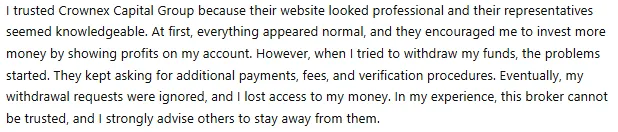
Public review data on Crownex Capital Group is not reassuring. Trustpilot shows a small number of reviews and a high overall score, but the profile is thin and one-sided, with only positive ratings visible on the page. That does not prove the broker is safe. It only shows that the public review sample is too weak to serve as a real trust signal. Trustpilot itself also notes that it does not fact-check reviews and that the broker has not invited reviews there, which limits how much confidence a reader should place in the score alone. Outside that page, the tone becomes darker. A BrokersView discussion includes a complaint describing large losses and refusal patterns around withdrawal, with the poster alleging that more money was demanded before funds could be released. That kind of complaint is common in broker-fraud cases. The exact figures may vary, and every online complaint should be read with care, but the structure of the grievance is familiar: deposits go in easily, then access to the money becomes blocked behind new demands. That is the part readers should pay attention to, because it is the red thread connecting many scams of this type.
A Detail Many People Miss
One detail that often gets ignored is how a scam broker uses “support” language. The victim is rarely told outright that a withdrawal will fail. Instead, the company creates a fog of procedures. There is always another form, another step, another department, another reason to wait. This delay is not accidental. Delay protects the fraudster because it gives the company time to keep control of the account and time to pressure the client into sending even more money. In scam disputes, that delay strategy can be just as damaging as the fake profit display itself. Another practical point is that victims should avoid paying extra “release” fees to get their own money back. That is one of the oldest tricks in the book. Once a company has started demanding extra payments to process a withdrawal, the safest assumption is that the money is not waiting to be released. It is being used as bait. The cleaner the recovery file, the better the chances of making a serious complaint stick.
Conclusion
After examining the available information about Crownex Capital Group, a clear picture begins to emerge. The broker presents itself as a professional financial company, but the information available from independent sources raises serious concerns about its reliability and transparency. The presence of regulatory warnings, questions surrounding the company’s legal status, and complaints from traders who experienced problems with withdrawals create a combination of risk factors that should not be ignored. One of the most important lessons investors can learn from cases like this is that a professional-looking website does not equal legitimacy. Modern scam brokers invest significant resources into creating an image of success and credibility. They use attractive designs, financial terminology, promises of expert support, and claims of secure trading conditions. For inexperienced traders, this can create a false sense of security. Unfortunately, by the time many victims realize that something is wrong, a substantial amount of money has already been deposited. The situation surrounding Crownex Capital Group demonstrates why independent verification is essential before opening an account with any online broker. Every company that accepts client funds should be able to provide clear information about its regulatory status, licensing, corporate structure, and legal responsibilities. When such information is vague, difficult to verify, or inconsistent with independent records, investors should treat this as a major warning sign rather than a minor detail. Another issue frequently reported in disputes involving questionable brokers is the withdrawal process. Depositing funds is usually simple and fast. Clients are encouraged to invest more, upgrade account levels, or participate in supposedly exclusive trading opportunities. However, when the time comes to withdraw money, many investors encounter unexpected obstacles. Additional fees may be requested, verification procedures may become unusually complicated, or support representatives may stop responding altogether. In some situations, clients are pressured to make further payments before they can supposedly access their own funds. Such practices are inconsistent with the behavior expected from a legitimate financial institution. Victims often blame themselves after discovering that they have been deceived. This reaction is understandable, but it is important to remember that fraudulent brokers are designed to appear convincing. Their sales teams are trained to build trust, create urgency, and exploit emotions such as excitement, confidence, and fear of missing opportunities. Even experienced investors have fallen victim to sophisticated online investment schemes. The responsibility lies with those who created and operated the deceptive platform, not with the people who believed the promises presented to them. For individuals who have already deposited money with Crownex Capital Group, taking immediate action is critical. Time is one of the most important factors in any recovery effort. The longer a victim waits, the more difficult it can become to trace transactions, preserve evidence, and use available financial recovery mechanisms. Every email, screenshot, payment confirmation, chat message, account statement, and withdrawal request can become valuable evidence later in the process. This is precisely where professional assistance can make a significant difference. DNB Forex Review specializes in helping victims of suspicious brokers organize their cases and pursue available recovery options. Rather than relying on guesswork or random advice found online, affected traders can receive guidance based on documented evidence and established recovery procedures. A properly prepared case has a much stronger chance of attracting the attention of banks, payment providers, and other relevant institutions than a complaint supported by incomplete information. The specialists at DNB Forex Review analyze the details of each case individually. They help clients identify how payments were processed, what evidence should be collected, and what recovery methods may be available. Depending on the circumstances, this may involve chargeback procedures, payment disputes, bank investigations, fraud reports, or other legal and financial actions. While no legitimate company can guarantee the return of funds, professional support often significantly improves the chances of achieving a positive outcome. Another reason to act quickly is that victims of broker scams are often targeted a second time. After losing money, some traders are contacted by so-called recovery agents who promise guaranteed refunds in exchange for upfront fees. In many cases, these “recovery services” are operated by the same networks that conducted the original fraud or by unrelated scammers seeking to exploit victims once again. Before paying anyone for assistance, investors should carefully verify who they are dealing with and whether the organization has a genuine track record of helping clients. The Crownex Capital Group case also serves as a reminder that prevention remains the most effective form of protection. Before sending money to any broker, investors should independently verify regulatory information, research reviews from multiple sources, examine withdrawal policies, and investigate the company’s history. A few hours of research can prevent months of stress and potentially significant financial losses. When all available information is considered together, Crownex Capital Group displays numerous characteristics commonly associated with high-risk brokerage operations. Questions regarding transparency, concerns about regulatory status, public warnings, and complaints from users create a pattern that deserves serious attention. Investors should approach the company with extreme caution and avoid relying solely on the marketing claims presented on its website. For those who have already become involved with the broker, the most important step is not to remain passive. Gather evidence, document every interaction, stop sending additional funds, and seek professional assistance as soon as possible. The earlier a recovery strategy begins, the greater the likelihood of preserving important evidence and pursuing available options effectively. DNB Forex Review can help victims navigate this difficult situation by providing structured guidance, analyzing the circumstances of the case, and assisting with the preparation of recovery claims. In disputes involving questionable brokers, organization, speed, and professional support often become the key factors that separate successful recovery efforts from missed opportunities. Ultimately, the story of Crownex Capital Group highlights a broader reality of the online trading industry. Not every company that presents itself as a broker deserves the trust of investors. Financial markets offer legitimate opportunities, but they also attract operators who exploit that interest for their own benefit. Staying informed, verifying every detail, and responding quickly to warning signs remain the best defenses against becoming the next victim. Those who have already suffered losses should remember that taking action today is far more effective than hoping the situation will resolve itself tomorrow.








I had problems with Crownex Capital Group after trying to withdraw my money. They told me many reasons why the payment could not be completed. In the end, I understood that something was wrong. I am searching for people who had a similar situation and information about how to get help with recovering lost funds.
Our team is ready to help you regain control of the situation. Submit a request today.