




Choosing a broker is one of the most important decisions for any trader. Unfortunately, not every company operating in the online trading industry deserves investors’ trust. EHA Markets presents itself as an international broker offering access to forex, cryptocurrencies, commodities, and other financial instruments. At first glance, the platform appears professional and promises favorable trading conditions. However, a closer examination reveals numerous concerns that should not be ignored. Various online reviews, complaints from former clients, and independent assessments have raised questions about the broker’s transparency, regulatory status, and withdrawal practices. In this review, we will analyze available information about EHA Markets, examine potential warning signs, discuss common complaints from traders, and explain how victims of questionable brokers may seek assistance from DNB Forex Review.
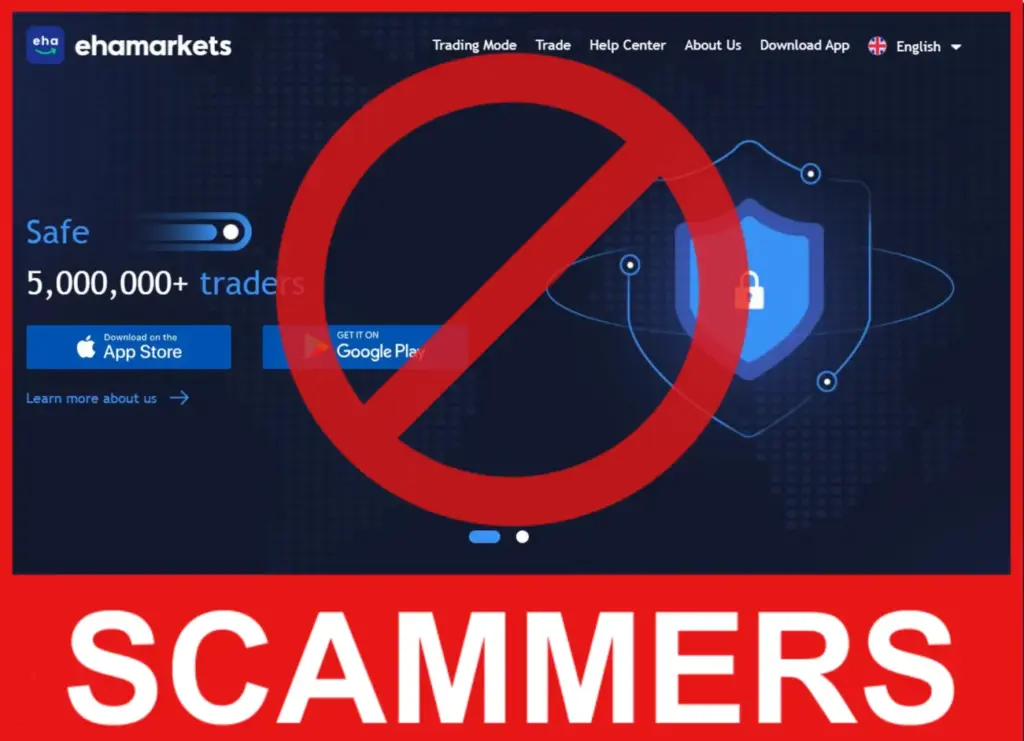
Information About the Fraudulent Broker
EHA Markets advertises itself as a broker providing access to global financial markets. The company claims to offer trading opportunities in forex, cryptocurrencies, indices, commodities, and other assets. The website highlights trading tools, educational materials, customer support, and various account options designed to attract both beginners and experienced traders. Like many online brokers, EHA Markets emphasizes ease of registration and promises a convenient trading experience. However, several independent review sources and user discussions suggest that the reality may differ from the marketing presentation. Many former clients report that opening an account and making a deposit was a simple process. Problems allegedly began later, particularly when users attempted to withdraw funds or requested account closure. Some traders describe long delays, repeated document requests, and communication difficulties with company representatives. Another issue frequently mentioned in online discussions involves aggressive sales practices. According to some reviews, account managers regularly encouraged clients to increase their investments by promising greater opportunities or improved trading results. Such tactics are commonly associated with high-risk brokerage operations. Although the broker promotes itself as a professional financial service provider, investors should carefully examine all available information before depositing funds.
Verification of Company Data
One of the first steps when evaluating any broker is verifying its legal and regulatory status. A trustworthy brokerage company usually provides clear information about its registration, licensing, and supervisory authorities. In the case of EHA Markets, independent reviewers have raised concerns about the absence of clear evidence of regulation by major financial authorities. Investors searching for information about the company’s oversight may find limited details regarding recognized regulatory licenses. The lack of transparent regulatory information is a significant risk factor because regulation provides important protections for clients. Regulated brokers are typically required to follow strict rules regarding client funds, reporting standards, and dispute resolution procedures. Questions have also been raised about the company’s ownership structure and corporate transparency. When investors cannot easily verify who controls a broker, accountability becomes more difficult to establish. For this reason, potential clients should independently verify all company information before making financial commitments.
Exposing the Broker as a Fraudster
Several warning signs appear repeatedly in discussions about EHA Markets. While none of them individually proves fraudulent activity, together they create a concerning picture. The most common issue involves complaints about withdrawal difficulties. Numerous traders claim that withdrawing funds was significantly more complicated than making deposits. Delays, additional verification requirements, and communication problems are recurring themes in negative reviews. Another concern is the reported pressure from account managers to deposit larger amounts of money. Aggressive sales tactics are often used by questionable brokers to maximize client investments. The limited availability of verifiable regulatory information also contributes to concerns. Investors should always be cautious when dealing with brokers whose legal status cannot be easily confirmed through reputable financial authorities. Taken together, these factors suggest that potential clients should exercise extreme caution before opening an account with EHA Markets.
Fraud Broker’s Deception Scheme
Many complaints describe a similar pattern. A potential client registers on the platform and makes an initial deposit. Shortly afterward, company representatives contact the trader and encourage additional investments. The trading account may initially show positive results, creating confidence and motivating the investor to deposit more money. As the invested amount grows, communication with account managers often becomes more frequent. Difficulties allegedly begin when the client attempts to withdraw funds. Some users report unexpected requirements, additional fees, or repeated requests for documents. Others claim that customer support becomes less responsive during the withdrawal process. This pattern closely resembles schemes frequently reported in cases involving high-risk or fraudulent brokers. Although individual experiences vary, investors should be aware of these warning signs and remain cautious.
How to Get Money Back from a Scam Broker
Victims of questionable brokers often believe that their money is gone forever. However, depending on the circumstances, recovery options may still exist. DNB Forex Review assists clients in analyzing broker-related disputes and identifying possible recovery strategies. Specialists examine transaction records, payment methods, account statements, communications with the broker, and other available evidence. The sooner a victim seeks assistance, the greater the chances of preserving important documentation. Recovery efforts may involve payment disputes, chargeback procedures, legal consultations, and other measures depending on the specific situation. Individuals who suspect they have been affected by unfair broker practices should avoid sending additional money and immediately gather all available evidence related to their account.
Negative Reviews About the Broker
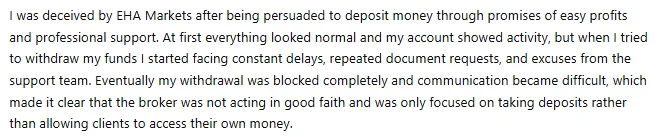
Online reviews of EHA Markets are mixed, but negative feedback follows several recurring themes. Many dissatisfied users report difficulties withdrawing funds, delayed responses from customer support, and problems resolving account-related issues. Some reviewers also mention persistent calls and emails encouraging larger deposits. Others claim that promises made during the registration process did not match their actual experience after becoming clients. While positive reviews can also be found online, potential investors should pay close attention to repeated complaints involving the same issues. Consistent patterns of negative feedback often provide valuable insight into a broker’s actual business practices.
How to Protect Yourself from Similar Brokers
Online trading can look simple and attractive from the outside. A few clicks, a quick registration, and suddenly you are “on the market” with access to forex, crypto, indices, and more. That simplicity is exactly what makes it dangerous when dealing with unreliable brokers. Companies like EHA Markets show how easily a professional-looking platform can hide serious risks behind marketing and smooth communication. The first and most important rule is verification — and not the kind provided by the broker itself. Any company can write on its website that it is “regulated,” “licensed,” or “international.” What really matters is whether this information can be independently confirmed through official financial regulators. Before depositing money, investors should always check the broker in databases of well-known authorities such as the FCA, CySEC, ASIC, or other recognized supervisory institutions. If a broker cannot be found there, or if the details do not match, this is already a strong warning sign. Another important step is understanding how easy it is to open an account versus how difficult it may be to withdraw funds. A common trick used by questionable brokers is to make deposits extremely fast and frictionless. Credit cards, crypto transfers, bank payments — everything is designed to feel simple and instant. However, withdrawal processes often become complicated later. This imbalance is one of the clearest indicators of risk. A trustworthy broker treats deposits and withdrawals with equal transparency. Investors should also be cautious of emotional pressure. Many users report that account managers contact them shortly after registration, offering “help,” “signals,” or “personal guidance.” At first, this may seem helpful, especially for beginners. But when communication starts to shift toward constant suggestions to deposit more money, upgrade accounts, or “take advantage of limited opportunities,” it becomes a manipulation tactic. Real financial professionals do not pressure clients into increasing investments repeatedly. A very useful personal safety strategy is to test withdrawals early. Before investing significant sums, it is wise to deposit a small amount and request a withdrawal. If a broker creates unnecessary obstacles even with a small test amount, it is highly likely that larger withdrawals will be even more difficult. This simple step can save investors from major losses later. Another key point is skepticism toward unrealistic promises. Any broker that guarantees profits, risk-free trading, or unusually high returns should be treated with extreme caution. Financial markets are inherently unpredictable. Even experienced traders face losses. So when a company presents trading as easy money with minimal risk, it is often a marketing illusion rather than reality. It is also important to pay attention to communication style. Reliable brokers usually provide structured, professional, and consistent support. In contrast, questionable platforms often rely heavily on phone calls, persuasive messaging, and urgency tactics. Phrases like “limited offer,” “exclusive opportunity,” or “your account will benefit if you deposit today” are designed to trigger emotional decisions rather than rational thinking. Technical transparency is another factor that should not be ignored. Legitimate brokers clearly explain where client funds are held, how orders are executed, and what fees apply. If this information is vague, overly complex, or difficult to verify, it becomes harder to trust the platform. Investors should also be careful with bonuses and promotional offers. While bonuses may seem attractive, they often come with hidden conditions that restrict withdrawals until certain trading volumes are reached. In some cases, these conditions are intentionally designed to make it difficult for clients to access their own money. Finally, one of the most effective protections is simply taking time. Fraudulent platforms often rely on urgency — pushing users to “act quickly” before they think too much. Legitimate investment decisions should never be rushed. A few extra hours or days spent researching a broker can prevent months or even years of financial stress. The experience of traders affected by platforms like EHA Markets shows a consistent pattern: the problems rarely appear at the beginning. Everything seems smooth until real money is involved and withdrawal is requested. That is why prevention is always more important than recovery. In the end, protecting yourself in online trading is not about avoiding the market — it is about choosing carefully where you enter it. Awareness, verification, patience, and skepticism are the strongest tools any investor can use.
Conclusion
EHA Markets is a broker that presents itself in a polished and modern way, offering access to popular financial markets and promising convenient trading conditions. At first sight, its website and marketing materials may create the impression of a standard international brokerage firm. However, when all available information is considered together — including user complaints, independent reviews, and transparency concerns — a much more cautious picture emerges. One of the main issues repeatedly mentioned is the lack of clear and verifiable regulatory oversight. In the financial industry, regulation is not just a formality; it is the foundation of investor protection. Licensed brokers are required to follow strict rules, keep client funds secure, and operate under supervision. When this element is missing or cannot be clearly confirmed, traders are left without reliable protection if something goes wrong. In the case of EHA Markets, this uncertainty alone is already a serious warning sign. Another recurring problem highlighted by users is the difficulty with withdrawals. While depositing funds is usually fast and simple, many complaints describe delays, repeated document requests, or unexplained obstacles when clients try to withdraw their money. Even if some of these cases are individual disputes, the repetition of similar stories across different platforms suggests a pattern that investors should not ignore. Equally concerning are reports of aggressive communication and pressure from account managers. Many traders describe being encouraged to invest more money shortly after registration, often with promises of better trading conditions or higher potential profits. This type of behavior is commonly associated with high-risk or questionable brokerage models, where the main focus is not long-term client success but continuous deposits. It is also important to highlight the psychological aspect of such platforms. Many users do not realize the risk at the beginning because everything seems professional and supportive. Early positive impressions, smooth onboarding, and friendly communication can create a false sense of trust. Only later, when larger sums are involved or withdrawal is requested, problems tend to appear. By that stage, many investors already feel trapped or confused about what steps to take next. Taken together, all these elements — unclear regulation, repeated withdrawal complaints, aggressive sales tactics, and lack of transparency — create a high-risk profile. This does not mean that every single user will have a negative experience, but it does indicate that the level of risk is significantly higher than what a typical retail investor should accept. For anyone who has already deposited money with EHA Markets and is experiencing difficulties, it is crucial not to act emotionally or make additional payments in hopes of “unlocking” funds. In many similar cases, further deposits only increase losses. Instead, all communication, receipts, transaction records, and account data should be carefully preserved. At this stage, professional assistance can make a real difference. DNB Forex Review specializes in helping victims of questionable brokers analyze their situation, understand what legal and financial options may still be available, and take structured steps toward potential fund recovery. This may include reviewing payment methods, preparing chargeback claims, gathering evidence, and coordinating further actions depending on the specific case. Finally, the most important lesson from situations like EHA Markets is prevention. The online trading space is full of opportunities, but also full of risks that are not always obvious at first glance. A professional-looking website, polite support staff, or attractive bonus offers are not proof of reliability. Real trust is built on regulation, transparency, and a consistent history of fair treatment of clients. EHA Markets serves as a reminder that investors should always take time to verify, question, and double-check before committing funds. In trading, caution is not a weakness — it is a necessary protection.






I want to share my experience because other investors should be careful with ehamarkets. I was persuaded to continue investing because the representatives showed me positive results and encouraged additional deposits. However, when I asked for my money back, the situation changed completely. I am now trying to recover my funds and find out whether other victims have received assistance in similar cases. Any information about the recovery process would be useful.
Our team will help you recover stolen funds; please submit a request.
After several months of trying to resolve my situation directly with ehamarkets, I understood that communication with them would not lead to a solution. I decided to seek professional advice regarding the recovery of my funds. My case required reviewing payment records and collecting evidence of communication with the platform. The process was not immediate, but I was able to recover a portion of my lost money. I hope my experience encourages other victims not to give up.
If this company has defrauded you, submit a request, and one of our specialists will contact you for a free consultation!