




Online trading and Forex platforms can appear to be a fast track to growing wealth. With glossy websites, slick branding, and promises of exceptional returns, many brokers look trustworthy at first glance. However, appearances can be very misleading. Elite Peak Capital has recently surfaced in the trading market, but not as a reputable broker. While it promotes access to multiple financial markets—Forex, cryptocurrencies, and commodities—a closer look exposes patterns often seen in scams and fraudulent operations. In an era where online trading scams are becoming increasingly sophisticated, it’s crucial for investors to approach brokers with caution before depositing funds. Many scam operators rely on convincing websites, persuasive marketing messages, and promises of guaranteed profits to lure unsuspecting clients. This article delves into Elite Peak Capital’s operations, exposing the risks, warning signs, and deceitful tactics used by this broker. It also emphasizes the importance of professional support for anyone attempting to recover funds lost to unscrupulous operators. Recognizing these warning signals helps investors make informed decisions and protect their money.
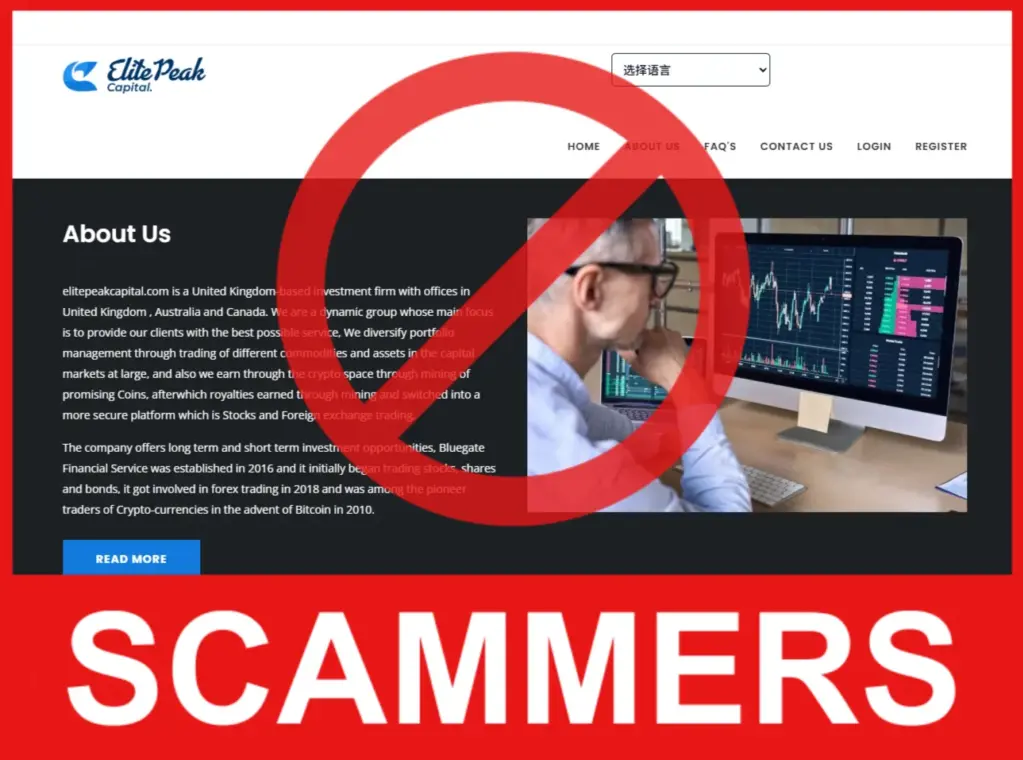
Information About the Fraudulent Broker
Elite Peak Capital positions itself as a modern broker offering a wide range of trading opportunities. The platform emphasizes global reach, sophisticated technology, and professional account management. However, these claims are largely unverifiable, and the company provides little credible information to confirm its legitimacy. The broker appears to have been launched only recently, and domain registration records reveal a lack of transparency. Contact options are limited and rely on generic email addresses instead of official corporate accounts. Key details, such as trading conditions, account types, fee structures, and withdrawal policies, are either vague or missing entirely. Unlike legitimate brokers, which provide detailed documentation for investors, Elite Peak Capital fails to offer clarity. Marketing materials highlight high returns and “elite trading opportunities,” but the associated risks of trading are downplayed or ignored. This approach is typical of scam brokers, who entice clients to deposit more money with the promise of quick gains. Online reports from former users indicate recurring issues with withdrawals, poor or nonexistent customer support, and pressure to add funds to unlock access to accounts. These behaviors are classic indicators of fraudulent activity.
Verification of Company Data
Before investing, it’s critical to confirm a broker’s regulatory status and company details. Licensed brokers operate under rules enforced by recognized authorities, ensuring fund protection, auditing, transparency, and ethical compliance. Elite Peak Capital, however, does not appear to hold any licenses from reputable financial regulators. Without proper oversight, investors have no assurances that their money is safe or that the broker operates ethically. Although the broker claims global operations and professional services, these assertions cannot be independently verified. The lack of proper contact information and audited records further undermines credibility. Legitimate brokers typically provide registration numbers, verified addresses, and audited financial statements. Elite Peak Capital does not, raising serious doubts about its legitimacy. An evaluation of the broker’s risk profile highlights multiple red flags: a recently registered website, opaque ownership details, and indicators of untrustworthy activity. Combined, these signs strongly suggest that the broker operates without oversight, a common characteristic of scams. Investors considering deposits face a high risk of financial loss.
Exposing the Broker as a Fraudster
Elite Peak Capital exhibits numerous hallmarks of a fraudulent operation rather than a legitimate broker. The most glaring issue is the absence of regulatory oversight. Licensed brokers are held accountable by authorities such as FCA, ASIC, or CySEC, which enforce compliance and protect investors. The fact that Elite Peak Capital is missing from these registries exposes clients to substantial financial risk. The broker’s marketing also promises high returns with minimal risk—claims that are unrealistic in any legitimate market. Transparency is limited, with terms and conditions, account types, fee schedules, and withdrawal policies either incomplete or entirely absent. This lack of clarity allows brokers to manipulate client accounts and demand additional funds under misleading pretenses. Customer reports frequently describe difficulties withdrawing money, poor communication, and repeated requests for extra deposits. Coupled with free email addresses and the absence of verifiable office locations, these patterns strongly indicate fraudulent intent. The behaviors match those observed in numerous known scams, confirming Elite Peak Capital as a high-risk broker.
Fraud Broker’s Deception Scheme
Scam brokers such as Elite Peak Capital follow a predictable pattern to exploit clients. Initially, they create a professional appearance and promise substantial returns to attract deposits. Investors are often encouraged to act quickly, under the impression of limited-time offers or exclusive opportunities. After funds are deposited, brokers often display fake profit dashboards or use account managers to simulate successful trading. This builds trust and prompts clients to invest even more. When investors attempt to withdraw their money, obstacles suddenly appear: verification fees, additional deposit requirements, or indefinite delays. These tactics effectively block access to client funds. By exploiting trust and urgency, fraudulent brokers maximize the amount they can extract before vanishing. Victims are often left with few options unless they seek professional recovery services.
How to Get Money Back from a Scam Broker
While retrieving money from an unregulated broker is challenging, it is possible with professional help. Recovery specialists can assess cases, trace payment methods, and take legal or financial measures to reclaim lost funds. This may include disputes with banks, payment providers, or financial authorities. Clients should collect all relevant documentation—account records, payment receipts, correspondence, and screenshots. Recovery professionals use this evidence to file formal complaints, negotiate with institutions, and coordinate with authorities. Expert services reduce stress for victims and significantly improve the chances of retrieving lost funds. Prompt action and strategic guidance are essential for successful recovery.
Negative Reviews About the Broker
Even though Elite Peak Capital is relatively new, reports from clients reveal recurring problems common to scams. Many describe difficulties withdrawing funds, disappearing account managers, and repeated demands for additional deposits. Support teams often become unresponsive once deposits are made. These experiences mirror other known broker scams and highlight the high-risk nature of the platform. Independent assessments and trust ratings reinforce these concerns. While the broker is new, the patterns are clear warning signs for potential investors.

Identifying High-Risk Brokers
When it comes to online trading, not every broker is trustworthy, and distinguishing legitimate platforms from fraudulent ones is critical for protecting your money. High-risk brokers often share certain characteristics that experienced investors have learned to recognize. Being aware of these red flags can prevent serious financial loss. One of the most obvious warning signs is the lack of regulatory licensing. Reputable brokers operate under licenses issued by recognized authorities, such as the FCA in the UK, ASIC in Australia, or CySEC in Cyprus. These authorities enforce strict rules that protect client funds, require brokers to maintain segregated accounts, and demand transparent reporting and audits. If a broker cannot provide verifiable licensing information, it should immediately raise concern. Operating without oversight is a hallmark of high-risk or fraudulent brokers. Another indicator is vague or misleading promotional messaging. Scam brokers often advertise “guaranteed profits,” “risk-free trading,” or “elite returns in just days.” In reality, all trading carries risk, and no legitimate broker promises guaranteed outcomes. Unrealistic claims of extraordinary returns are a classic lure used to manipulate inexperienced investors into depositing funds quickly, often under pressure or with a sense of urgency. Pressure tactics are another common feature of high-risk brokers. They may assign personal account managers who insist on immediate deposits, encourage investors to upgrade accounts, or claim that limited-time offers will expire if funds are not deposited right away. These psychological tactics exploit human urgency and trust, making investors feel they must act immediately to secure profits. Professional brokers never rely on pressure or coercion—they provide information and allow clients to make informed decisions. Withdrawal difficulties are perhaps the clearest warning sign. High-risk brokers frequently introduce obstacles when a client tries to access their funds. These obstacles can include unverifiable “verification fees,” sudden demands for additional deposits, long unexplained delays, or outright refusal to process withdrawals. Legitimate brokers maintain straightforward withdrawal processes, with clear policies outlined from the beginning. When a broker repeatedly blocks or complicates access to your money, it signals serious red flags. The lack of transparency in company information is another indicator. High-risk brokers often operate with anonymous ownership, provide no physical office address, and rely on generic email accounts rather than professional corporate channels. They may also hide or obscure key details about account types, trading conditions, or fee structures. Investors who cannot verify the broker’s identity or operational structure are at significantly higher risk. Fake testimonials and manipulated trading dashboards are additional tools used by fraudulent brokers. These brokers may display fabricated client reviews or create false account statistics to make investors believe that others are consistently profiting. New clients see these false indicators and are encouraged to deposit more money, not realizing that the results are entirely fabricated. Always question testimonials that appear too perfect or lack verifiable sources. High-risk brokers also often have recently registered websites and short domain histories. While this alone is not proof of fraud, combining it with other red flags, such as lack of regulatory information and opaque ownership, strengthens the warning signal. New domains can be used to operate temporarily before disappearing once sufficient money has been collected from victims. Unprofessional communication channels are another common trait. Legitimate brokers offer official corporate emails, live chat, and verified phone numbers with professional support teams. In contrast, high-risk brokers often rely on free email services, messaging apps, or social media accounts, which are difficult to trace or hold accountable. Investors should also watch for unrealistic promises about trading strategies. Brokers claiming guaranteed profits from automated systems, AI trading tools, or secret strategies that supposedly outperform the market are usually trying to entice deposits under false pretenses. In reality, all markets carry uncertainty, and no system can guarantee consistent profits. Finally, a consistent pattern across multiple indicators should serve as a warning. A broker may have just one suspicious trait, but combining several—lack of licensing, vague information, pressure tactics, withdrawal obstacles, anonymous ownership, and unrealistic promises—creates a clear picture of a high-risk operation. Being aware of these patterns allows investors to act proactively, conduct thorough research, and avoid brokers designed to exploit trust rather than provide legitimate trading services. In summary, identifying high-risk brokers requires vigilance, critical thinking, and skepticism. Investors must prioritize verifiable licensing, clear company information, realistic profit claims, and professional communication. Awareness of these warning signs, combined with careful research, significantly reduces the likelihood of falling victim to fraudulent brokers and ensures a safer trading experience.
Conclusion
Elite Peak Capital presents itself as a legitimate trading broker, but a deeper examination reveals numerous warning signs of fraud. Lack of regulation, hidden ownership, unrealistic profit claims, and reports of blocked withdrawals all point to a high-risk operation. Investors should exercise extreme caution and seek professional guidance if they have already deposited funds. Recovering money from such brokers is possible with the help of experts familiar with the tactics and schemes used by scams. Professional services can handle disputes, liaise with financial institutions, and navigate legal channels to increase the likelihood of recovering lost funds. Swift and strategic action is crucial for anyone attempting to reclaim their money. The case of Elite Peak Capital highlights the dangers posed by unregulated online brokers. Awareness, critical evaluation, and professional support are essential tools for protecting investments, avoiding financial loss, and recovering funds from fraudulent operators. Every investor deserves transparency, accountability, and security, and platforms like Elite Peak Capital fail on all counts.







I contacted Elite Peak Capital after seeing information about their investment opportunities, but my experience ended with financial losses. When I asked questions about my withdrawal request, I received explanations that did not resolve the issue. I am interested in finding out whether victims of this platform can take legal action or use recovery services to attempt to retrieve their funds.
Submit a request to receive professional assistance and a consultation.
I was affected by Elite Peak Capital and want to share my concerns with others who may have had the same problem. The platform appeared trustworthy at the beginning, but later I faced difficulties withdrawing my funds. I am currently exploring different options for recovering my money and would appreciate guidance from people who understand financial fraud cases and the procedures involved.
If you have been deceived, do not delay—submit a request, and we will review your case.