The online trading world attracts thousands of new investors every day. Unfortunately, alongside legitimate brokers, there are also questionable platforms that exist primarily to extract money from unsuspecting users. Grand Gate Agency appears to be one of those cases where a professional-looking website may be masking deeper issues. At first glance, everything seems convincing: promises of high returns, personalized support, and access to global financial markets. However, experienced investors know that such claims should always be verified. When we take a closer look at Grand Gate Agency, multiple warning signs begin to emerge — the kind typically associated with fraudulent broker operations. This review aims to break down what is really known about this platform, how it operates, and why potential investors should approach it with extreme caution.
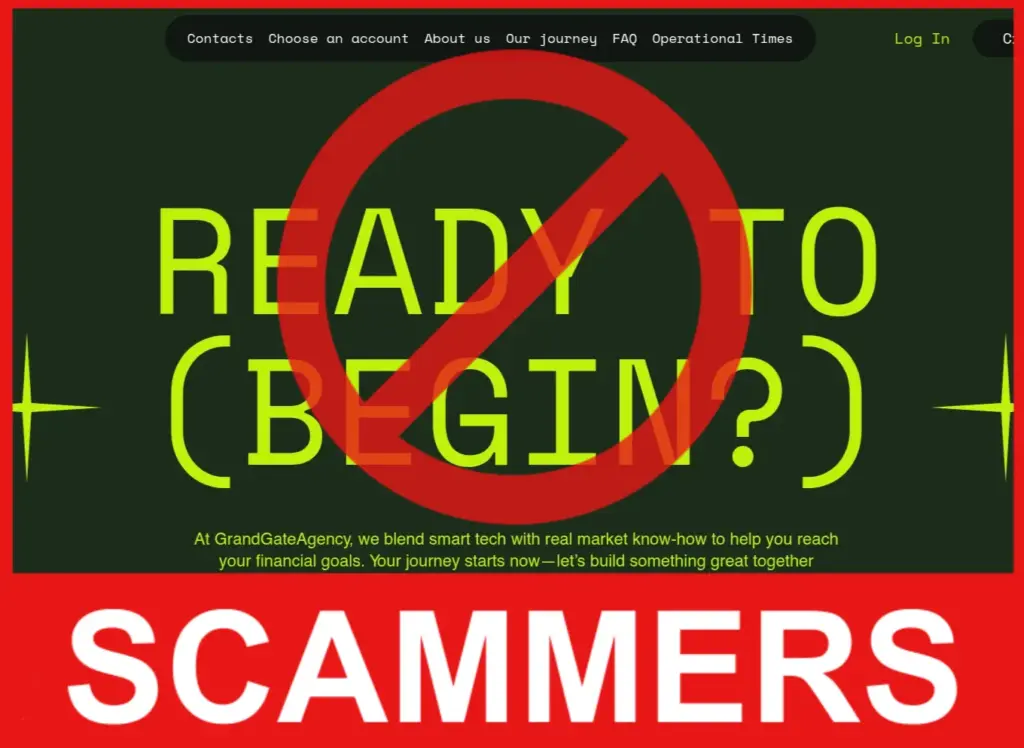
Information About the Fraudulent Broker
Grand Gate Agency presents itself as a modern brokerage service offering trading in forex, cryptocurrencies, stocks, and other assets. The website emphasizes accessibility and profitability, targeting both beginners and more experienced traders. However, when analyzing the details, there is a noticeable lack of transparency. Key trading conditions such as spreads, commissions, leverage limits, and execution methods are either vaguely described or completely absent. This is highly unusual for a legitimate broker, as regulated companies are required to disclose such information clearly. Another concern is the trading platform itself. Grand Gate Agency refers to a “user-friendly terminal,” but does not specify whether it is a well-known platform like MetaTrader or a proprietary system. In many scam cases, brokers use custom-built platforms that simulate trading activity rather than connecting to real markets. Additionally, the overall content of the website appears generic. Much of the language is promotional rather than informative, focusing on emotional triggers like “financial freedom” and “guaranteed success” instead of providing verifiable facts.
Verification of Company Data
One of the most critical steps when evaluating a broker is verifying its legal status. In the case of Grand Gate Agency, this process raises serious concerns. The platform either does not provide clear licensing information or presents details that cannot be independently confirmed. Legitimate brokers are regulated by authorities such as the FCA, CySEC, or ASIC, and their licenses can be easily checked in official databases. The absence of verifiable regulation is a major red flag. In many similar cases, brokers claim registration in offshore jurisdictions. While this is not illegal, it significantly reduces accountability. Offshore registrations often do not provide meaningful investor protection, making it difficult to recover funds in case of disputes. Another issue is the domain history. Fraudulent brokers frequently operate under newly registered domains despite claiming years of experience. This mismatch between stated history and actual digital footprint is a strong indicator of potential deception.
Exposing the Broker as a Fraudster
Grand Gate Agency demonstrates several characteristics commonly associated with scam brokers. First, aggressive communication tactics. Potential clients are often contacted by persistent “account managers” who push for immediate deposits. These interactions can become increasingly pressuring over time. Second, the lack of transparency in operations. Without clear information about regulation, ownership, and trading conditions, users are left in the dark about how their money is actually being handled. Third, withdrawal issues. This is one of the most frequently reported problems with fraudulent platforms. Users may be asked to pay additional fees, taxes, or verification charges before being allowed to withdraw funds — which ultimately never happens. Finally, psychological manipulation plays a major role. Clients are encouraged to invest more money by being shown fake profits or told they are on the verge of a “major opportunity.”
Fraud Broker’s Deception Scheme
The scheme usually begins with online advertising or cold calls. A potential victim is invited to try trading with a small initial deposit. After registration, a so-called account manager steps in to guide the user. At first, everything appears legitimate — the platform shows profits, and the client feels confident. As trust builds, the user is encouraged to deposit larger amounts. The displayed balance grows, reinforcing the illusion of success. However, when the client attempts to withdraw funds, problems arise. They may be asked to pay additional fees or meet certain conditions. Eventually, communication stops altogether, and access to funds is lost. This cycle is a well-known pattern in online investment fraud.
How to Get Money Back from a Scam Broker
If you have been affected by a broker like Grand Gate Agency, it is important to act quickly. Recovering funds independently can be extremely difficult, especially when dealing with offshore entities. DNB Forex Review specializes in assisting victims of fraudulent brokers. Their experts analyze each case individually, gathering evidence and identifying the best recovery strategy. One of the primary tools used is the chargeback process. If the deposit was made via bank card, it may be possible to dispute the transaction and request a reversal. However, this requires proper documentation and a clear explanation of the fraud. In addition, legal avenues can be explored. This includes filing complaints with financial institutions, regulators, and payment providers. Professional support significantly increases the chances of success. The key factor is timing — the sooner action is taken, the better the outcome.
Negative Reviews About the Broker
Online reviews and user feedback provide valuable insight into a broker’s real behavior. In the case of Grand Gate Agency, available information points to a pattern of negative experiences. Many users report difficulties withdrawing funds. Some claim that their accounts were blocked after requesting a withdrawal, while others describe endless delays and new payment demands. There are also reports of aggressive sales tactics. Clients mention being pressured into depositing more money, sometimes even being encouraged to take out loans. A common theme is the sudden disappearance of support once problems arise. While communication may be frequent at the beginning, it often declines sharply after deposits are made. These patterns are consistent with known fraudulent practices in the online trading industry.

Additional Warning Signs Investors Should Not Ignore
When it comes to identifying a potentially fraudulent broker like Grand Gate Agency, the obvious red flags are only part of the picture. In reality, many scams are built on smaller, less noticeable details that, when combined, reveal the true nature of the operation. Paying attention to these subtle signals can save investors from serious financial loss. One of the most overlooked warning signs is inconsistency. This can appear in many forms: different information across pages of the website, vague or changing answers from support agents, or contradictions in company claims. For example, a broker might state that it has “years of experience,” yet its domain or online presence suggests it was created only recently. These inconsistencies are not accidental — they often indicate that the platform was assembled quickly without real operational history behind it. Another important factor is the behavior of account managers. At first, communication tends to be extremely active, even overly friendly. Managers may call frequently, message daily, and present themselves as personal financial advisors. But this level of attention usually has a purpose: to build trust quickly and push the client toward larger deposits. Once the money is transferred, the tone often changes. Responses become slower, less helpful, or disappear altogether. This shift in behavior is one of the clearest indicators of a manipulative setup. Payment methods also deserve close attention. Fraudulent brokers often encourage the use of specific channels such as cryptocurrency, obscure payment processors, or direct transfers that are difficult to trace or reverse. Even when bank cards are accepted, clients may later be told to use alternative methods for “faster processing” or “special opportunities.” This is rarely about convenience — it’s about making fund recovery harder. Another subtle but critical sign is the lack of risk disclosure. Real financial services always emphasize that trading involves risk and that losses are possible. In contrast, suspicious platforms tend to minimize or completely ignore this aspect. Instead, they highlight success stories, “proven strategies,” and high win rates. This creates a distorted perception of reality, especially for inexperienced investors who may not yet understand how volatile financial markets can be. The structure of bonuses and promotions is another area where problems often arise. Offers such as “deposit bonuses” or “insured trades” may sound attractive, but they frequently come with hidden conditions. These conditions can make it nearly impossible to withdraw funds until unrealistic trading volumes are reached. In practice, this becomes a tool to lock users into the platform indefinitely. Technical aspects of the platform itself can also be revealing. For instance, if the trading interface lacks transparency — no clear order execution details, no verifiable price feeds, no connection to known liquidity providers — it may not be a real trading environment at all. Some platforms simulate trades internally, meaning users are not participating in real markets. This allows operators to manipulate results, including showing artificial profits to encourage further deposits. Customer support quality is another telling factor. Legitimate brokers usually offer multiple communication channels, including phone support, live chat, and email, with clear response times. In contrast, unreliable platforms often rely on limited or controlled communication methods. Messages may go unanswered, or replies may be generic and unhelpful. In more serious cases, accounts can be blocked entirely once withdrawal requests are made. There is also the issue of online reputation. While any company can have a few negative reviews, a pattern of similar complaints is a strong warning sign. When multiple users report the same problems — inability to withdraw funds, pressure to deposit more money, sudden account restrictions — it indicates a systemic issue rather than isolated incidents. Ignoring such patterns can be a costly mistake.
Conclusion
When everything is put together, Grand Gate Agency fits a pattern that has become all too familiar in the world of online trading scams. On the surface, it presents itself as a modern, opportunity-driven platform. But once you look past the polished design and persuasive language, the structure begins to fall apart. The lack of transparency, missing regulatory proof, questionable communication tactics, and reports of withdrawal issues all point in one direction — elevated risk for anyone who decides to trust this broker with their money. One of the biggest mistakes many people make is underestimating how convincing these platforms can be. Fraudulent brokers are no longer crude or obvious. They invest in professional-looking websites, trained sales agents, and psychological techniques designed to build trust quickly. By the time doubts start to appear, victims are often already financially and emotionally invested. That’s exactly why caution is not just recommended — it’s absolutely necessary. Another critical point is the illusion of control. Platforms like Grand Gate Agency often allow users to see “profits” in their accounts. This creates a false sense of success and encourages further deposits. But in reality, these numbers may have no connection to real market activity. It’s a controlled environment where the outcome is dictated by the operator, not by actual trading conditions. Understanding this mechanism is key to recognizing the danger early. It’s also important to address the emotional side of these situations. Victims of such schemes often feel embarrassment or hesitation when things go wrong, which leads to delays in taking action. This is exactly what scammers rely on. The longer a person waits, the harder it becomes to recover funds. Acting quickly is not just helpful — it can be decisive. Prevention, of course, is always better than recovery. Before investing with any broker, take the time to verify licenses, check independent sources, and question anything that seems too good to be true. A legitimate financial company will never pressure you into making quick decisions or hide essential information. However, if the worst has already happened, it’s important to understand that the situation is not hopeless. Professional assistance can significantly improve the chances of recovering lost funds. This is where specialists like DNB Forex Review play a crucial role. They understand how these schemes operate, know where to look for evidence, and can guide victims through complex procedures such as chargebacks and formal complaints. In many cases, people try to resolve the issue on their own and quickly realize how complicated it is. Banks, payment systems, and regulatory bodies require properly structured claims and supporting documentation. Without experience, it’s easy to make mistakes that reduce the chances of success. Working with professionals helps avoid these pitfalls and gives a clearer path forward. Ultimately, the story of Grand Gate Agency is a reminder of how important awareness and critical thinking are in today’s digital financial environment. Opportunities do exist, but so do risks — and sometimes they are carefully disguised. Staying informed, asking the right questions, and seeking help when needed are the best tools any investor can rely on. If there is one takeaway from this review, it’s this: never rush into financial decisions, especially when pressure is involved. Take a step back, verify everything, and remember that real investments are built on transparency and trust — not promises and urgency.