




The online trading industry has long attracted not only honest brokers, but also hundreds of questionable projects that hide behind beautiful websites, loud promises, and fake stories about financial success. Harindale.trade is one of those platforms that has recently started attracting attention for all the wrong reasons. At first glance, the site looks polished and professional. It talks about market opportunities, experienced analysts, profitable trading conditions, and stable income. But when you start checking the details, the picture changes dramatically. A growing number of independent monitoring services, review platforms, and financial watchdogs are raising concerns about Harindale.trade. The broker has already been mentioned in connection with regulatory warnings, suspicious activity, lack of licensing, and signs commonly associated with fraudulent investment schemes. Many users who trusted the platform report the same problems: pressure from managers, aggressive persuasion to deposit more money, blocked withdrawals, and sudden silence once the client asks for a refund. The most dangerous thing about projects like Harindale.trade is that they are designed to look trustworthy. Fraudulent brokers understand perfectly well that modern investors are more careful than before. That is why scammers invest heavily in website design, fake success stories, fabricated statistics, and manipulative communication. Their goal is simple — convince people to deposit as much money as possible before disappearing or inventing excuses to avoid returning funds. In this review, we will take a detailed look at Harindale.trade, analyze the available information about the company, examine regulatory data, discuss the broker’s suspicious behavior, and explain the schemes often used by this type of platform.
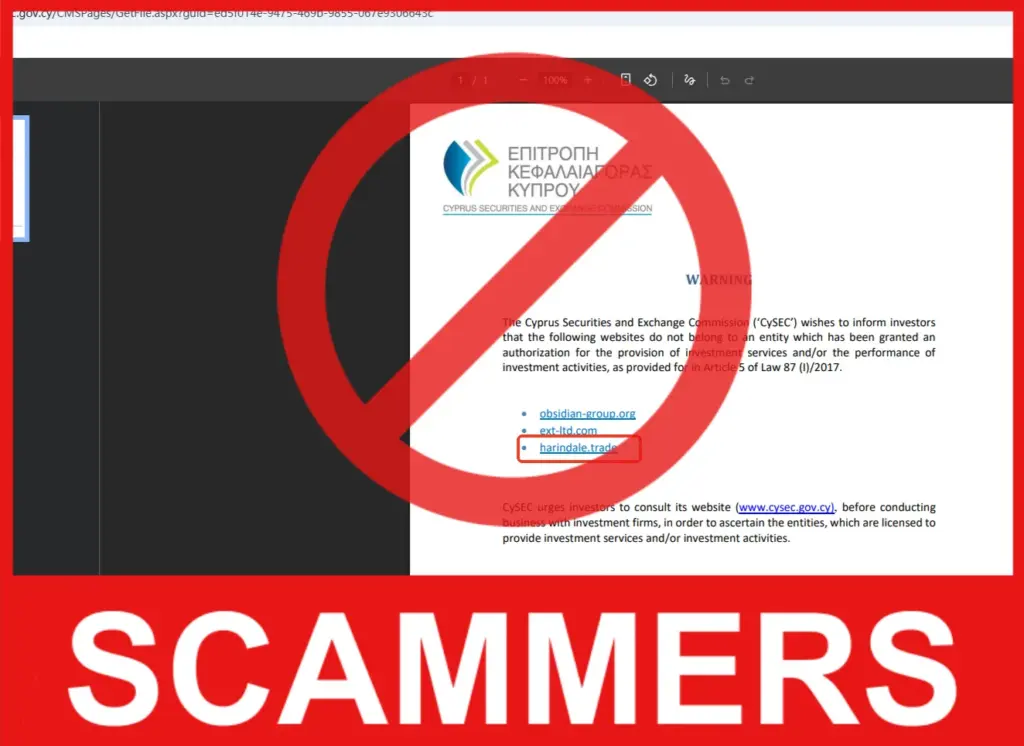
Information About the Fraudulent Broker
Harindale.trade presents itself as an international trading platform supposedly offering access to financial markets, investment opportunities, and professional support from experienced analysts. The website uses typical marketing phrases that are often seen on questionable brokerage projects: “market opportunities,” “expert guidance,” “stable income,” and “advanced trading solutions.” The goal is obvious — create the impression of a reliable financial company capable of helping clients earn money quickly. However, when analyzing the broker more deeply, serious problems begin to appear. One of the first alarming signs is the lack of transparent information about the company itself. Reliable brokers usually provide detailed legal documentation, registration data, licensing numbers, names of regulators, office addresses, and clear information about management. In the case of Harindale.trade, most of this information is either missing entirely or impossible to verify independently. Several monitoring platforms that specialize in checking financial companies have already classified Harindale.trade as a high-risk or potentially fraudulent broker. Review sites mention the absence of proper regulation, suspicious registration details, hidden ownership information, and a very young domain age. These are classic warning signs frequently associated with temporary scam platforms. Another suspicious factor is the broker’s attempt to create an illusion of international legitimacy. Some websites reviewing Harindale.trade noted references to Luxembourg registration, but checks through official regulatory databases reportedly failed to confirm the existence of a properly licensed investment company connected to this broker. In the financial industry, this is extremely important. A legitimate broker cannot legally provide investment services without authorization from financial regulators. The website itself appears designed more for attracting deposits than for providing transparent financial services. Instead of detailed legal information, visitors are greeted with emotional marketing promises and generalized statements about profit opportunities. Fraudulent brokers often rely on this exact approach because inexperienced investors are more likely to react emotionally than to verify licenses and legal documentation.
Verification of Company Data
One of the most important steps when evaluating any broker is checking official company information. Serious financial firms understand that trust depends on transparency. They openly publish registration details, licenses, legal addresses, regulatory numbers, risk disclosures, and corporate documents. In the case of Harindale.trade, verifying this information becomes extremely difficult. Independent review services have already pointed out that the broker lacks confirmed regulation. This is a major issue because regulation is the foundation of investor protection. Licensed brokers are required to follow strict financial rules, maintain client fund segregation, undergo audits, and comply with anti-fraud standards. Unregulated platforms can operate almost without oversight. One of the strongest warning signs came from reports connected to the Cyprus Securities and Exchange Commission (CySEC). Public warnings linked to Harindale.trade described the platform as an unregistered or unlicensed entity offering financial services without authorization. Such warnings are not issued lightly. Regulators publish them when they believe a company may pose a risk to consumers. Another suspicious detail involves the company’s domain registration. Information from scam-analysis platforms indicates that the website was registered only recently and that ownership details are hidden behind privacy protection services. While privacy protection itself is not illegal, many fraudulent brokers deliberately hide ownership information to avoid accountability. The lack of a verifiable corporate structure is equally concerning. There is no clear information about the people managing the platform, the legal entity responsible for customer funds, or the jurisdiction governing client agreements. Legitimate financial institutions usually emphasize these details because they increase credibility. Scam projects often avoid transparency because revealing real identities creates legal risks for organizers. Review platforms also noted inconsistencies related to claimed registration locations. Some references allegedly pointed to Luxembourg, but checks reportedly failed to confirm authorization from local regulators. This mismatch between marketing claims and official records is another classic red flag. It is also important to understand how scam brokers manipulate legal information. Many fraudulent platforms copy fragments of documents from legitimate companies, invent fake registration numbers, or misuse addresses connected to unrelated businesses. Ordinary users often do not verify these details carefully, which allows scammers to appear more legitimate than they actually are. Another issue involves contact information. Trustworthy brokers typically provide several transparent communication channels, including registered office addresses, direct phone lines, compliance departments, and verified corporate emails. Harindale.trade appears to provide only limited information, making it difficult for affected clients to pursue complaints or legal claims.
Exposing the Broker as a Fraudster
Fraudulent brokers rarely present themselves as obvious scams. Modern financial scammers carefully study psychology and marketing. They know how to create trust quickly and how to manipulate emotions. Harindale.trade demonstrates many warning signs that experienced investigators commonly associate with deceptive investment operations. The first major red flag is the absence of verified regulation. This alone significantly increases the risk level. Without regulation, clients have almost no protection if the broker refuses withdrawals or manipulates trading activity. Another suspicious sign is the broker’s aggressive marketing style. Scam brokers often contact potential clients through online advertisements, social media, messenger apps, or unexpected phone calls. They promise financial independence, easy profits, and “exclusive opportunities.” In reality, these promises are designed to trigger emotional decisions. Victims frequently describe a similar pattern. At first, a manager behaves politely and professionally. The client is encouraged to make a small deposit. Then the platform may display fake profits to create excitement and trust. Once the victim believes the system works, managers begin pressuring them to invest larger amounts. Some users report that so-called analysts convince them to take loans, use credit cards, or borrow money from relatives to “increase profits.” This is one of the most dangerous aspects of investment fraud. The goal is not long-term cooperation — it is maximizing the amount of money extracted from the victim.
Withdrawal problems are another common complaint linked to suspicious brokers. Initially, clients may even receive small payouts. This tactic is often used to strengthen trust. But when larger withdrawal requests appear, problems begin. The broker may suddenly demand additional fees, taxes, insurance payments, account verification charges, or minimum turnover requirements. In many cases, these additional payments never solve the issue. After extracting more money, the scammers either stop responding or invent new excuses. Some victims report blocked accounts or accusations of violating platform rules. Technical manipulation is also possible. Since unregulated brokers control their own trading platforms, they can potentially manipulate charts, spreads, prices, or account balances. Clients may believe they are participating in real market trading while all activity is simulated internally.
Fraud Broker’s Deception Scheme
Understanding how scam brokers operate is extremely important because these schemes are carefully planned and psychologically sophisticated. Harindale.trade appears to follow methods commonly used by fraudulent online brokers targeting inexperienced investors. The scheme usually begins with advertising. Potential victims may encounter sponsored posts, online banners, social media videos, fake celebrity endorsements, or promises of easy income through trading. Some scammers even use fake news articles designed to look like legitimate media reports. Once a person registers on the website, communication begins almost immediately. A “financial expert” or “account manager” contacts the client and starts building trust. At first, conversations are friendly and encouraging. The manager claims to help beginners understand the market. The victim is then persuaded to make an initial deposit. Often the starting amount is relatively small because scammers know people are more willing to risk limited sums at the beginning. After the deposit, the trading account may suddenly show profits. This stage is extremely manipulative. The displayed profits are often not connected to real trading activity. Their purpose is to create emotional excitement and convince the client that larger investments will produce larger returns. Managers continue calling regularly, creating a sense of partnership. They may praise the client’s “success,” discuss market trends, and suggest increasing the investment to unlock premium services or VIP trading conditions. As trust grows, pressure intensifies. Victims are encouraged to deposit more money urgently because of “special market opportunities.” Some people end up transferring life savings or taking loans. The problems usually begin when the client attempts to withdraw money. Suddenly, the broker introduces unexpected conditions. Clients may be told they need to pay taxes in advance, verify accounts through additional deposits, or meet impossible trading turnover requirements. Sometimes scammers use psychological pressure during this stage. Managers may claim that withdrawing funds early will cause losses or destroy profitable positions. They may also accuse clients of violating company policies. If the victim refuses to continue paying, communication often stops. Phone numbers stop working, emails remain unanswered, and accounts become inaccessible.
How to Get Money Back from a Scam Broker
Losing money to a fraudulent broker can be emotionally devastating. Many victims feel ashamed, angry, or hopeless after realizing they may have been deceived. However, one important thing must be understood: scammers rely on silence and fear. The sooner victims act, the greater the chances of recovering at least part of the lost funds. This is where specialists such as DNB Forex Review can become extremely important. Companies focused on helping victims of broker fraud understand how these schemes operate and what steps should be taken immediately after discovering the scam. The first and most important recommendation is not to send additional money to the broker. Fraudsters often continue demanding payments under different excuses: taxes, commissions, account activation fees, or legal expenses. Victims should understand that legitimate financial companies do not require endless surprise payments to release withdrawals. DNB Forex Review specialists usually begin by analyzing the entire situation in detail. This includes examining payment methods, transaction histories, communication with managers, platform screenshots, and agreements provided by the broker. One possible recovery path involves chargeback procedures. If deposits were made using bank cards, there may be opportunities to dispute transactions through the issuing bank. Timing matters greatly in such situations, which is why victims should act quickly.
Negative Reviews About the Broker
Although Harindale.trade is a relatively new project, negative information about the broker is already appearing online. Review platforms, scam-monitoring websites, and financial discussion forums contain growing concerns regarding the company’s reliability. One of the most common complaints involves withdrawal problems. Users claim that depositing money is simple and fast, but withdrawing funds becomes extremely difficult. According to reports, clients encounter endless delays, unexpected fees, or complete silence from support representatives. Another recurring issue is aggressive communication from account managers. Several affected users describe constant pressure to deposit larger sums. Managers allegedly insist that additional investments are necessary to achieve significant profits or avoid financial losses. Some complaints also mention suspicious platform behavior. Victims report seeing rapid profits on their accounts, only to later discover that withdrawals were impossible. This pattern is extremely common among fraudulent brokers because fake profits are used to encourage larger deposits. Independent review services have also expressed concerns. Scam-analysis websites gave Harindale.trade very low trust ratings due to hidden ownership information, lack of licensing, and the recent creation of the domain. Financial monitoring platforms additionally highlighted regulatory warnings connected to the broker. Public warnings from financial authorities significantly increase concerns because regulators usually investigate companies before publishing official alerts. Another detail that appears repeatedly in reviews is the lack of transparency. Users complain that they cannot obtain clear information about the legal company behind the platform, the location of offices, or the regulatory authority supposedly supervising operations. Many victims also describe emotional manipulation. Managers reportedly build personal relationships with clients, speak confidently about market opportunities, and create urgency around investments. Once the victim loses money or requests withdrawals, the friendly attitude often disappears.

Hidden Risks Victims Often Discover Too Late
One of the biggest mistakes inexperienced investors make is focusing only on promised profits while ignoring operational risks. Scam brokers understand this perfectly. They design their platforms to keep clients emotionally excited and distracted from obvious warning signs. A major hidden danger involves access to personal documents. Many fraudulent brokers request passport copies, bank statements, utility bills, and card photos under the pretext of account verification. Victims often provide this information without realizing how dangerous it can be. Identity documents collected by scam operations may later be used for illegal activities, fake accounts, or additional fraud schemes. In some cases, victim information may even be sold to other criminal groups. Another overlooked risk involves remote access software. Some brokers ask clients to install programs supposedly needed for “technical assistance” or “trading support.” Through remote access tools, scammers can potentially view sensitive financial information or gain access to online banking systems. Psychological pressure is another important aspect rarely discussed openly. Fraudulent brokers often use trained sales agents skilled in manipulation. They create emotional dependency, build trust over time, and exploit fear or greed. Victims frequently describe feeling embarrassed after discovering the fraud. Unfortunately, this shame prevents many people from seeking help quickly. Scammers rely on this silence because fewer complaints reduce the chances of investigations.
Conclusion
After analyzing the available information about Harindale.trade, the overall picture appears deeply troubling. The broker demonstrates numerous warning signs commonly associated with fraudulent or highly unreliable investment platforms. Among the most concerning issues are the lack of verified regulation, hidden ownership information, recent domain registration, regulatory warnings, and growing complaints from users regarding withdrawals and aggressive sales tactics. The broker appears to rely heavily on marketing promises and emotional persuasion rather than transparency and legal accountability. This is a dangerous combination in the financial industry. Potential investors should understand that unregulated brokers create enormous risks. Without regulatory oversight, clients may have little or no protection if the platform refuses withdrawals, manipulates accounts, or disappears entirely. The experiences described by affected users follow a pattern repeatedly observed in online investment scams. Victims are encouraged to trust account managers, invest increasing amounts of money, and believe in unrealistic profits. But once withdrawal requests appear, communication problems and financial obstacles begin. It is also important to remember that financial scammers constantly evolve their methods. Professional-looking websites and convincing communication do not guarantee legitimacy. Modern fraud operations are often highly organized and psychologically sophisticated. Anyone who has already deposited money with Harindale.trade should act carefully and quickly. Do not send additional payments under any circumstances. Preserve all evidence related to transactions and communication. Specialists such as DNB Forex Review can help victims evaluate possible recovery options, organize evidence, prepare complaints, and navigate the complicated process of fighting broker fraud. The most important lesson from the Harindale.trade case is simple: never trust promises of easy money from anonymous online brokers. Always verify licenses independently, research company history, and remain skeptical of aggressive investment offers.







I lost a significant amount of money after dealing with Harindale. What convinced me initially was how professional everything looked, from the website to the communication with account managers. For several weeks, I was shown positive trading results and encouraged to increase my investment. However, when I requested a withdrawal, the process became complicated. I was told that additional verification and unexpected fees were required before my funds could be released. Has anyone managed to recover funds from Harindale, and what steps would you recommend taking first?
If you believe you were scammed, please leave a request on our website and our team will contact you shortly.