




The online trading world continues to attract thousands of people who hope to earn money through forex, cryptocurrencies, and CFD instruments. Unfortunately, this same environment has also become a breeding ground for dishonest platforms that disguise themselves as legitimate brokers. One of these suspicious companies is Tradock operating through the website tradock.me. At first glance, the project looks modern and convincing, but closer examination shows a completely different picture. Many users who encounter platforms like this are drawn in by promises of fast income, professional trading support, and simple investing conditions. Everything is designed to build trust quickly. However, once real money is deposited, the situation often changes. Complaints from traders, patterns seen in similar schemes, and the general lack of transparency suggest that Tradock should be treated with extreme caution. This review is intended to help readers understand how such brokers operate and why they often lead to financial losses.
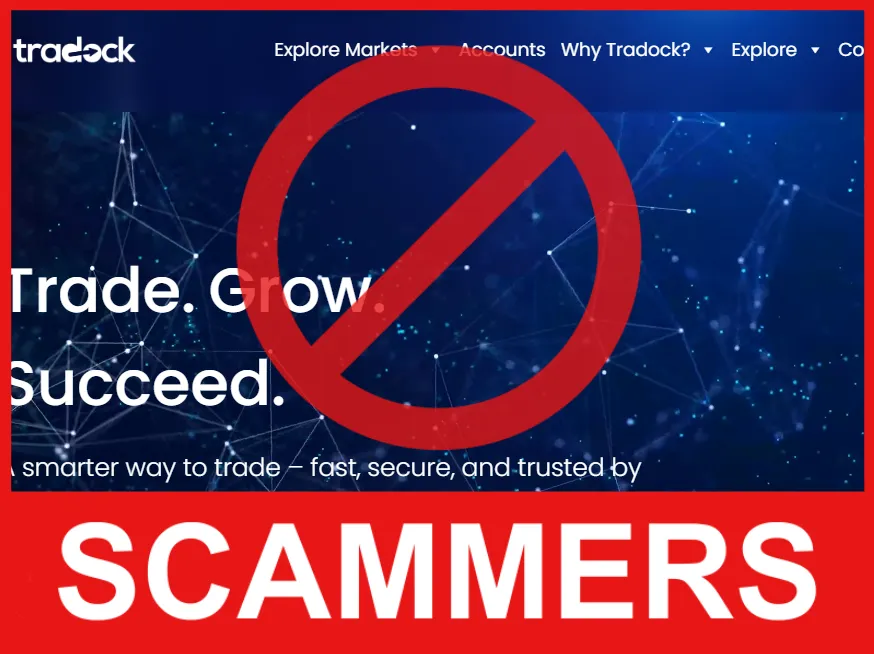
Information About the Fraudulent Broker
Tradock presents itself as a global trading platform offering access to forex markets, digital assets, commodities, and various CFD instruments. The website is designed to create an impression of professionalism. It usually includes trading dashboards, promotional materials, and descriptions of advanced tools supposedly available to clients. However, when the surface layer is removed, serious concerns appear. The platform provides very little concrete information about its real operations. There is no clear explanation of who owns the company, how it is structured, or where it is physically located. In legitimate financial services, this information is always available and easy to verify. Communication with clients is typically handled through online chat or email. Users often report being contacted by so-called account managers who encourage them to deposit funds and increase their trading volume. These conversations are highly persuasive and focused mainly on encouraging further investment rather than explaining real risks. Another common characteristic is the lack of realistic trading conditions. Promises of stable profits, low risk, and advanced trading tools are frequently highlighted. In reality, financial markets are volatile and no broker can guarantee profit. The presence of such promises is a strong warning sign. In addition, platforms like Tradock often rely heavily on marketing tactics that target beginners. People with little trading experience are especially vulnerable because the platform appears simple and supportive at first. Over time, the main goal becomes clear, which is to encourage larger deposits rather than facilitate genuine trading activity.
Verification of Company Data
One of the most important steps in evaluating any broker is checking whether it is regulated by a recognized financial authority. In the case of Tradock, this verification process reveals a lack of reliable information. Legitimate brokers operate under strict supervision from regulators such as those in the United Kingdom, Cyprus, Australia, or other established jurisdictions. These licenses can be independently confirmed through official databases. For Tradock, no such verifiable licensing information is available. The company does not clearly disclose registration documents that would confirm its legal status. There is also no transparent record of its corporate structure or management team. In many cases like this, websites rely on offshore registrations that are difficult or impossible to verify properly. Another issue is anonymity. The domain information is typically hidden, and there is no confirmed physical office that clients can contact. This is a major difference compared to legitimate brokers, which are required to provide full legal transparency. Without verified regulation, clients have no protection in case of disputes. This means that if funds are lost or withdrawals are blocked, there is no financial authority that can intervene on behalf of the client. This lack of oversight significantly increases the risk of financial harm.
Exposing the Broker as a Fraudster
Several behavioral patterns associated with Tradock strongly resemble those found in fraudulent trading schemes. One of the most common issues reported by users is difficulty withdrawing funds. While deposits are processed quickly, withdrawal requests often face delays, additional conditions, or are rejected entirely. Another concerning pattern is the behavior of account managers. Users frequently describe being pressured to invest more money after making an initial deposit. These representatives often present themselves as experts who understand the market and can help maximize profits. In reality, their main objective appears to be increasing client deposits. There are also reports of trading results that appear artificially positive at first. Many users notice that their accounts show steady growth early on, which encourages them to continue investing. However, once they attempt to withdraw funds, problems begin to arise. A lack of external auditing is another serious concern. Without independent verification, there is no proof that trades are executed in real financial markets. In many fraudulent systems, trading dashboards are simulated rather than connected to actual liquidity providers. Aggressive communication tactics also play a role. Users are often contacted repeatedly and encouraged to act quickly, with messages suggesting that investment opportunities are limited. This pressure-based approach is commonly used in scam environments to prevent users from taking time to evaluate risks properly.
Fraud Broker’s Deception Scheme
Fraudulent brokers typically follow a structured process designed to extract as much money as possible from clients. Tradock appears to operate in a similar way. The process usually begins with attraction. Potential clients are drawn in through advertisements or online promotions that emphasize easy profits and low risk. The messaging is designed to create excitement and curiosity. Once a user registers, the next stage involves an initial deposit. This amount is usually small, making it easier for users to trust the platform. After the deposit, clients are often shown positive trading results, even if no real market activity is taking place. As trust increases, account managers encourage larger investments. They may claim that higher deposits unlock better trading conditions or more profitable opportunities. Some users are even persuaded to invest significant savings based on these promises. At a certain point, withdrawal requests begin to fail. The platform may introduce new conditions such as additional fees, verification requirements, or tax payments before funds can be released. These requirements are often unclear and constantly changing. Eventually, communication may slow down or stop entirely. In some cases, user accounts are restricted or blocked. At this stage, victims realize that recovering funds becomes extremely difficult without professional assistance.
How to Get Money Back from a Scam Broker
Recovering money from fraudulent brokers is challenging, but there are still possible options depending on how the funds were transferred. The first step is to collect all available evidence. This includes transaction records, correspondence, account screenshots, and any documents related to deposits and withdrawals. The recovery process depends heavily on the payment method used. If payments were made through bank cards, there may be an option to dispute transactions through the issuing bank. This process involves proving that the service was not delivered as promised. In cases involving cryptocurrency, recovery is more complex but not impossible. Blockchain transactions can sometimes be traced, and specialized methods can be used to identify fund movement. However, this requires technical expertise and legal coordination. Professional assistance plays an important role in these cases. Specialists experienced in dealing with fraudulent brokers understand how such companies operate and how to apply pressure through financial institutions and legal channels. They can also assist in preparing formal complaints and guiding victims through recovery procedures. Time is critical. The longer the delay, the lower the chances of recovering funds, especially if money has already been transferred between multiple accounts or converted into cryptocurrency.
Negative Reviews About the Broker
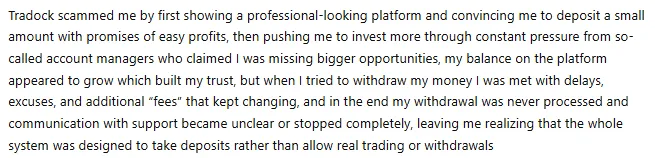
Feedback from users who have interacted with platforms like Tradock tends to follow a consistent pattern. Many people report that the experience starts positively, with friendly communication and helpful guidance from support representatives. However, problems usually begin after deposits increase. One of the most frequent complaints is withdrawal refusal. Users describe waiting for long periods without receiving their funds or being asked to provide additional payments before withdrawals can be processed. Some users mention that their accounts were suddenly restricted after they requested withdrawals. In these cases, access to the trading platform is blocked, and communication with support becomes limited or disappears entirely. There are also reports of strong pressure tactics used to convince clients to invest more money. Individuals who hesitate are often told that they are missing important opportunities or that their current investment level is too low for meaningful returns. A particularly concerning pattern is the encouragement of additional deposits through emotional manipulation. Some users claim they were persuaded to take financial risks they did not fully understand, believing that profits were guaranteed. Overall, the feedback paints a picture of disappointment and financial loss rather than successful trading experiences.
Additional important warning signs
Beyond the most obvious issues, there are several subtle indicators that often help identify fraudulent brokers early. One of them is the absence of educational content. Legitimate brokers usually provide detailed information about trading risks, market behavior, and strategy development. Scam platforms tend to focus only on profit potential. Another warning sign is unrealistic consistency in results. Real financial markets are unpredictable, and constant profit growth is not realistic. When platforms show overly stable returns, it often indicates manipulation. Lack of transparency in pricing and execution is also a concern. Clients rarely receive clear explanations of how trades are processed or where liquidity comes from. This makes it impossible to verify whether real market activity is taking place. Finally, emotional pressure is a key tactic. Legitimate financial institutions encourage careful decision making, while fraudulent platforms often push users to act quickly without time for reflection.
Conclusion
After reviewing all available information about Tradock and comparing it with the typical behavior of unregulated online brokers, the overall picture becomes quite clear and worrying. This is not a standard financial service provider with transparent operations and real market access. Instead, it shows many of the same characteristics seen in platforms that eventually lead users into financial loss. The most important conclusion is the lack of trust signals. There is no verifiable regulatory supervision, no clear corporate identity, and no reliable proof of real trading activity. In legitimate brokerage companies, these elements are always visible and easy to confirm. In this case, everything is either hidden, unclear, or impossible to verify independently. That alone already places the platform in a high-risk category. Another key issue is the behavior reported by users. The pattern is repeated in many similar cases across the online trading industry. Everything begins smoothly. Clients are welcomed, guided, and encouraged to deposit small amounts. The platform appears functional, and early trading results may even look positive. This stage is carefully designed to build confidence. However, the situation changes when users try to withdraw funds or when they start depositing larger amounts. This is usually the turning point. Requests become delayed, rejected, or linked to additional conditions that were never mentioned before. Some users report being asked to pay extra fees, taxes, or verification charges before any withdrawal can be processed. These requirements are rarely logical and often change repeatedly, which creates confusion and frustration. At the same time, communication from account managers often becomes more aggressive. Instead of assisting clients, the focus shifts to encouraging further investments. Clients may be told that they are missing opportunities or that their current trading level is too low to generate real profit. This psychological pressure is a common tactic used in high-risk and fraudulent schemes. The longer users stay inside such a system, the more difficult it becomes to recover funds. In many cases, accounts are eventually restricted or fully blocked after repeated withdrawal attempts. Communication may stop completely, leaving clients without access to their money or support. It is also important to understand that platforms like Tradock rarely operate alone. They are usually part of a broader network of similar websites that appear and disappear over time. Names may change, branding may be updated, but the operational model remains the same. This is why victims often discover that the company they trusted no longer exists in any official form once problems begin. From a financial perspective, the risk is not limited to small losses. Many users report losing significant savings, and in some cases even borrowed money. The emotional impact is often severe, as victims initially believe they are investing in a legitimate opportunity. This trust is gradually replaced by confusion, stress, and the realization that recovering funds is not straightforward. This is exactly where professional assistance becomes important. DNB Forex Review specialists focus on cases involving questionable brokers and help clients understand what options are still available. Depending on the payment method used, there may be possibilities such as chargeback procedures, transaction disputes, or tracing of funds through financial channels. In more complex situations, legal steps may also be required to build a structured claim. What matters most is speed. In cases like this, time is one of the most critical factors. The longer the delay, the more difficult it becomes to track funds or challenge transactions. Fraudulent platforms often move money quickly through multiple systems, making recovery harder over time. The final and most important takeaway is simple. Tradock shows too many warning signs to be considered a safe or reliable broker. Lack of regulation, withdrawal problems, aggressive marketing behavior, and consistent negative user experiences form a pattern that cannot be ignored. Even if the platform appears professional on the surface, the internal structure suggests a high level of risk. For anyone who has already interacted with this broker, the situation should be treated seriously. It is not just about trading mistakes or market losses. It is about potential exposure to a system designed in a way that makes withdrawals difficult and deposits easy. Recognizing this early can make a significant difference in limiting damage. In such situations, seeking help is not an overreaction but a practical step. DNB Forex Review exists to support victims of financial fraud, analyze each case individually, and guide people through possible recovery options. While no outcome can ever be guaranteed, taking action is far better than waiting and hoping the problem will resolve itself. In conclusion, Tradock should be approached with extreme caution, and in many cases avoided entirely. The combination of unclear regulation, user complaints, and behavioral red flags strongly suggests that it does not operate as a legitimate investment platform. For affected users, the most important step is not to continue depositing funds, but to begin exploring recovery options immediately with professional assistance.






Several months ago, I lost a significant amount of money through TraDock. The pressure tactics used by their representatives were very convincing, especially when they promised higher returns if I increased my investment. Once I understood that I was likely dealing with a fraudulent operation, I contacted specialists who deal with financial scam cases. The process has not been quick, but I have already received updates regarding some of the transactions. For anyone in a similar position, don’t wait too long before seeking assistance, because delays may make recovery attempts more difficult.
You’re absolutely right. If you’ve been scammed by this company, please submit a request with us, and our specialist will contact you for a free consultation!